Portobello Road
Antiques on Saturday, pastel houses, and Notting Hill around it
- Area Notting Hill
- Type Market
- Time needed 1h 15m
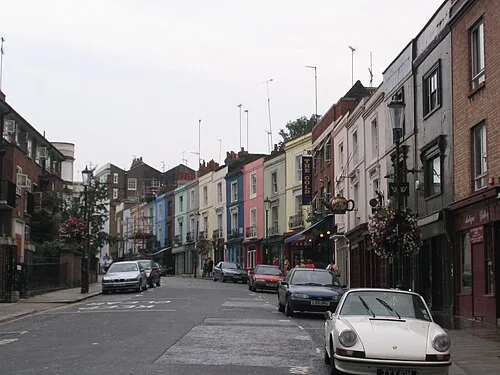
Portobello Road runs for about two miles through Notting Hill and holds one of London's longest-established street markets, with the antiques and bric-a-brac section at its southern end. The market trades on several days but the antiques stalls, which are the reason most people come, are a Saturday event. The street itself is lined with the pastel-painted terraced houses the area is known for, and much of what visitors photograph is simply the street. It is a public road with no entrance and nothing to buy a ticket for.
Open in the planner → Tours and entry ticketsGetting there
Notting Hill Gate, on the Central, Circle and District lines, is about five minutes' walk from the southern end: leave the station, head north up Pembridge Road and turn left into Portobello Road. Ladbroke Grove, on the Circle and Hammersmith and City lines, is the better choice for the middle and northern stretches, about four minutes' walk east. Westbourne Park, on the same two lines, serves the far north end and the Westway. From central London reckon on fifteen to twenty minutes on the Central line to Notting Hill Gate. The 52, 452, 7 and 23 buses serve the surrounding streets. If you are walking the whole market, start at the south end and work north, which is slightly downhill.
What you see
The southern stretch, from Chepstow Villas down towards Elgin Crescent, is the antiques end: arcades and shopfronts full of silver, old maps, coins, cameras, costume jewellery and ceramics, with stalls out on the pavement on market days. The painted houses on Portobello Road itself and on the side streets off it, especially around Colville Terrace and Denbigh Terrace, are the ones most often photographed. Further north past Elgin Crescent the market changes to fruit, vegetables, cheese and bread, which is the part local people actually use. Beyond Lancaster Road come the clothes and household goods, then the vintage clothing concentrated in and around Portobello Green and the shops under the Westway flyover, which is where the Friday trade is. Look out for the Electric Cinema, one of the oldest working cinemas in the country, and the old Portobello Road sign and street-name tiles. The Westway itself, carrying the A40 on concrete piers over the market, is a striking piece of 1970s engineering seen from beneath.
What to pair it with
Kensington Gardens and the Serpentine are about fifteen minutes' walk south-east, and Hyde Park beyond that. Holland Park, with its Japanese garden, is a similar distance south-west. Little Venice is around twenty-five minutes north-east on foot, or three stops on the Hammersmith and City line from Ladbroke Grove.
When to go
Saturday is the day the market is worth the journey. That is when the antiques dealers, the full run of stalls and the arcades are all open together, and it is the only day the market is at full strength. The cost is crowds: from about eleven until three on a Saturday the southern end is shoulder to shoulder and slow. Arrive by nine or half past nine for stalls open and room to look. Friday is the second-best day, with vintage clothing at the north end and fewer people. Monday to Thursday the general market is a modest local affair and most of the antiques arcades are shut, so there is little point travelling for it. Sunday the market does not trade, though the shops and cafes are open. Avoid the Notting Hill Carnival weekend in late August entirely unless the carnival is what you came for; the market does not run and the streets are closed.
What is hard about it
Saturday crowds are genuinely unpleasant between late morning and mid-afternoon, with pickpocketing a real problem in the crush at the southern end. Prices in the antiques arcades are set for tourists and visitors who do not know the market will pay well over value; haggling is expected and there is a lot of reproduction material sold as old. On any day other than Saturday or Friday there may be very little market at all, which disappoints people who have travelled across London for it. The street is long, about two miles end to end, and there is no shortcut back other than walking or picking up a bus. Public toilets are scarce and cafes fill up. Nothing here is free in the sense of being an attraction — it is a shopping street, and if you are not buying there is perhaps an hour in it.
Common questions
How long do you need at Portobello Road?
Around seventy-five minutes covers the antiques end and the painted houses at a steady walk. Allow two to three hours on a Saturday if you want to browse the arcades and reach the vintage stalls at the north end.
Which day is Portobello Market actually worth visiting?
Saturday, when the antiques dealers and the full market are trading. Friday is a reasonable second choice for vintage clothing; Monday to Thursday the market is small and many arcades are closed, and it does not trade on Sunday.
Is there an entrance fee for Portobello Market?
No. It is a public street and free to walk down at any time; only what you buy costs anything.
More of the same kind
- Leadenhall MarketOrnate Victorian arcade, painted green and maroon, quiet at weekends
- Borough MarketFood market under the railway arches, trading on the site since the 1100s
- Camden MarketCanalside stalls, street food and the remains of London's punk trade