Regent's Park
Nash terraces, the rose garden in Queen Mary's Gardens, and the zoo
- Area Regent's Park
- Type Park
- Time needed 1h 15m
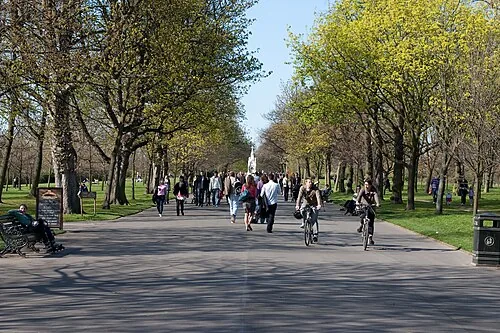
Regent's Park covers about 395 acres in north-west London, laid out from 1811 by John Nash as a park ringed by cream stucco terraces, several of which still stand along the Outer Circle. Inside it are London Zoo at the northern end, the Open Air Theatre, and Queen Mary's Gardens with the largest formal rose collection in London. Primrose Hill, just over the canal to the north, gives the view back over the city.
Open in the planner → Tours and entry ticketsGetting there
Regent's Park station on the Bakerloo line is closest to the southern entrance, about five minutes from Oxford Circus. Baker Street on the Bakerloo, Circle, Jubilee, Metropolitan and Hammersmith and City lines is five minutes' walk from the south-west corner and is the most useful interchange. Great Portland Street on the Circle, District and Hammersmith and City lines serves the south-east. For the zoo and the northern end, Camden Town on the Northern line is a fifteen-minute walk, and St John's Wood on the Jubilee line serves the west. The canal towpath from Camden Lock to the zoo is a pleasant twenty-minute walk.
What you see
From the southern gates the Broad Walk runs the length of the park in a straight line, with the Nash terraces visible behind the trees on the Outer Circle. The Inner Circle encloses Queen Mary's Gardens, planted in the 1930s, where thousands of roses in formal beds peak in June, with a small lake, a waterfall and the Japanese garden island on the eastern side. The Open Air Theatre sits inside the Inner Circle and stages plays and musicals through the summer in a bowl of seating under the trees. North-west of there the boating lake curls round in several arms, with rowing boats and a large heronry. London Zoo occupies the far northern end, bordering the Regent's Canal, and holds listed buildings including Lubetkin's 1934 penguin pool, now empty of penguins but preserved. Walk out of the north gate, cross the canal and climb Primrose Hill for the skyline view south across the whole park to the City.
What to pair it with
London Zoo and the Open Air Theatre are inside the park itself, Camden Market is twenty minutes north-east along the canal towpath, and Madame Tussauds and Baker Street are just outside the south-west corner.
When to go
June is the month for Queen Mary's Gardens, when the roses are fully out and the scent carries across the Inner Circle; by August they are past their best. Summer evenings for the Open Air Theatre, which plays whatever the weather. Early morning on the Broad Walk and the boating lake is quiet and good for birds. Weekend afternoons in warm weather fill the southern lawns and the zoo queues. Autumn gives the best light from Primrose Hill. The gates close at dusk.
What is hard about it
The park is large and the things in it are far apart — the southern gate to the zoo is a good half-hour walk, and Queen Mary's Gardens to Primrose Hill is another thirty minutes. The rose garden is genuinely dull outside its season, which catches out visitors arriving in early spring or late autumn. London Zoo is ticketed, expensive by the standards of a day out, and needs booking at busy times; the Open Air Theatre is ticketed too and has no roof, so a wet evening is a wet evening. Cafes are spread thin and the ones near the lake queue. Paths are flat but long, and gates close at dusk, which is early in winter.
Common questions
How long do you need in Regent's Park?
Around seventy-five minutes for the Broad Walk, Queen Mary's Gardens and the boating lake. Half a day if you add London Zoo, and another hour for Primrose Hill.
Is London Zoo inside Regent's Park?
Yes, at the northern end, bordering the Regent's Canal. It is separately ticketed and booking ahead is normally advisable.
When are the roses in Queen Mary's Gardens at their best?
Early to mid June for the main flush, with a lesser second showing later in summer. Outside that window the beds are not the reason to come.
More of the same kind
- St James's ParkThe oldest royal park, with a lake, pelicans and the best view of the palace
- Hyde Park350 acres with the Serpentine, Speakers' Corner and swimming in summer
- Kensington GardensThe Albert Memorial, the Italian Gardens and Peter Pan
- Greenwich ParkDeer, chestnut avenues and the best skyline view in London from the hill
Part of these routes
- North London hillsAn overgrown Victorian cemetery, the heath above it and the zebra crossing on Abbey Road.
- Knightsbridge and the parksThe Edwardian food halls, the arch at the end of Oxford Street and the green between them.
- London at lengthEverything the other routes cover, spread over eight unhurried days with nothing rushed.