Greenwich Park
Deer, chestnut avenues and the best skyline view in London from the hill
- Area Greenwich
- Type Park
- Time needed 45m
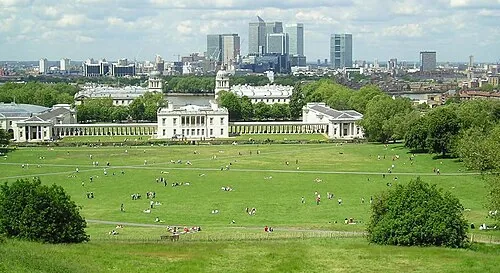
Greenwich Park is the oldest of London's enclosed royal parks, walled in 1433, and covers about 180 acres rising from the river to the hilltop where the Royal Observatory stands. The view north from the top, over the Queen's House and the Old Royal Naval College to Canary Wharf and the City beyond, is the best skyline view in London and the reason most visitors climb it. The park also holds a small herd of deer, avenues of chestnut and the remains of a Roman building. It is free and open every day.
Open in the planner → Tours and entry ticketsGetting there
Cutty Sark on the DLR is about ten minutes' walk to the park gates at the bottom, then a steep climb. Greenwich station, on the DLR and national rail from London Bridge, is similar. Maze Hill or Blackheath station, both on the rail line from London Bridge, put you at the top of the park and avoid the hill entirely, which is the better plan if the climb is a concern — Blackheath Gate leads straight onto the level ground by the Observatory. From central London allow twelve minutes by train from London Bridge to Greenwich or Maze Hill, or thirty to forty minutes by DLR from Bank. The Thames Clipper to Greenwich Pier takes about an hour from Westminster and leaves a fifteen-minute walk to the viewpoint. Buses 53, 54, 129, 177, 180, 188, 199, 286 and 386 serve the gates.
What you see
Come in at the riverside end by St Mary's Gate and the Avenue runs straight up the hill ahead of you, lined with horse chestnuts, with the ground rising steadily. The grass terrace beside the statue of General Wolfe at the top is the viewpoint: from here the Queen's House sits exactly on the axis with the twin domes of the Old Royal Naval College behind it and the river and towers beyond, a composition laid out deliberately in the seventeenth century. Below the terrace the hillside is steep enough that people roll down it, and a paving line marks the meridian outside the Observatory wall. South and east across the top of the park is the Flower Garden, a formal planting with mature specimen trees and a pond, and beyond it the Wilderness, a fenced enclosure where the fallow and red deer are kept — they are visible through the fence but not approachable. Near the Wilderness stands the hollow trunk of Queen Elizabeth's Oak, a tree that died in the nineteenth century and fell in 1991 and is left lying where it came down. On the eastern slope, fenced and marked, are the footings of a Roman building, probably a temple, and nearby an Anglo-Saxon burial mound group. The Ranger's House, a Georgian villa on the Blackheath side, holds a collection of medieval and Renaissance art on a separate ticket. There is a boating pond, a bandstand, tennis courts and a cafe near the Blackheath Gate end.
What to pair it with
The Royal Observatory stands at the top of the hill and is the obvious pairing. The National Maritime Museum and Queen's House are inside the park's northern edge and both free. Blackheath, with its pubs and the open heath, is straight out of the southern gate; the Cutty Sark and Greenwich Market are at the bottom of the hill.
When to go
The view north is best in the hour after sunrise or in the hour before sunset, when the light is across the buildings rather than behind them; at midday you are looking into the sun towards the river and photographs come out flat. Autumn, from mid-October, is the park at its best, with the chestnut avenues turning and the low light. Spring brings the Flower Garden. Weekends and warm evenings crowd the viewpoint terrace heavily and the grass can be packed in summer. Early morning on any weekday is quiet apart from runners. The park closes at dusk, with gate times varying through the year — check before you go. The deer are most active and visible early and late.
What is hard about it
The hill is the main difficulty: a sustained climb of around forty metres from the river gates, with no shortcut, and on a hot day it is hard work. Paths are mostly surfaced but the grass slopes are uneven and muddy after rain. The viewpoint terrace is small for the number of people who want to stand on it at sunset, and the railing is often lined with tripods. The deer enclosure is large and well fenced and you may see nothing at all on a cold day, which disappoints children. Toilets are at the top near the Observatory and near Blackheath Gate only, a long way apart. Parts of the park have been under restoration works in recent years with sections fenced off. There is no entry to the Observatory from the park without a ticket.
Common questions
How long do you need in Greenwich Park?
About forty-five minutes to walk up the Avenue, take in the view from the General Wolfe terrace and come back down. Add half an hour for the Flower Garden and the deer enclosure.
Where is the best view in Greenwich Park?
The terrace beside the statue of General Wolfe, just outside the Royal Observatory, looking north along the axis of the Queen's House to Canary Wharf. It is free and does not need an Observatory ticket.
Can you avoid the climb up Greenwich Park?
Yes. Arrive at Maze Hill or Blackheath station instead of Greenwich and walk in at the top of the park, which brings you out on level ground near the Observatory and the viewpoint.
Nearby
- Royal Observatory, GreenwichThe prime meridian, Harrison's sea clocks and the view back over the river
- Cutty SarkThe last tea clipper, raised on supports so you can walk beneath the hull
- National Maritime MuseumBritain at sea, including Nelson's coat from Trafalgar, free to enter
More of the same kind
- St James's ParkThe oldest royal park, with a lake, pelicans and the best view of the palace
- Hyde Park350 acres with the Serpentine, Speakers' Corner and swimming in summer
- Kensington GardensThe Albert Memorial, the Italian Gardens and Peter Pan
- Regent's ParkNash terraces, the rose garden in Queen Mary's Gardens, and the zoo
Part of these routes
- Greenwich and the meridianA tea clipper, the naval collections, the hill with the view and the line the world sets its clocks by.
- London from aboveFour high places, chosen so the queues and the light fall in the right order.
- London in five daysA fuller first visit: the centre, the City, the museums, the South Bank and a day in Greenwich.
- London at lengthEverything the other routes cover, spread over eight unhurried days with nothing rushed.