Westminster Cathedral
Striped Byzantine-revival Catholic cathedral with a lift up the campanile
- Area Victoria
- Type Church
- Time needed 45m
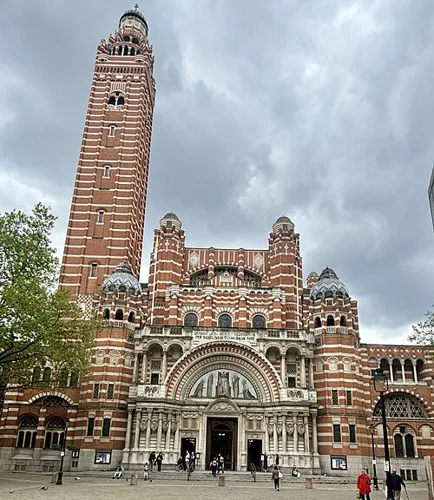
Westminster Cathedral, just off Victoria Street a few minutes from Victoria station, is the mother church of Catholic England and Wales, and it is not Westminster Abbey. Built between 1895 and 1903 to John Francis Bentley's design, it is Byzantine revival in banded red brick and white stone, with a campanile 83 metres tall that you can ride a lift up. Entry to the cathedral is free, the interior is unlike anything else in London, and most visitors to the city walk past without going in.
Open in the planner → Tours and entry ticketsGetting there
Victoria is three minutes' walk: Victoria, Circle and District lines, National Rail to the south coast and Gatwick, and the coach station. St James's Park on the Circle and District lines is five minutes the other way. The cathedral is set back from Victoria Street behind a piazza, which is why it is easy to miss from the street. Buses along Victoria Street stop at the piazza.
What you see
The first surprise is the ceiling, or the absence of one: the upper walls and domes of the nave are still bare dark brick, because the mosaic scheme that was planned for the whole interior was never finished and is only partly complete more than a century on. The effect is enormous, dim and cavernous, and arguably better than the finished version would have been. Lower down the walls are lined in dark marble from a long list of quarries, and the side chapels are fully decorated in gold mosaic, each quite different: work the way round them, since the contrast between the blazing chapels and the sooty nave is the point. Along the nave piers are Eric Gill's Stations of the Cross, carved in low relief in Portland stone between 1914 and 1918, severe and much admired. The Lady Chapel at the east end is the most completely realised mosaic space. Then take the lift up the campanile for a view over Victoria, the Abbey, Parliament and the roofs of Belgravia, from a viewing level that is open to the air through stone openings.
What to pair it with
Westminster Abbey and the Houses of Parliament are a ten-minute walk east. Buckingham Palace is ten minutes north through St James's Park. Tate Britain is fifteen minutes south.
When to go
Mornings on weekdays are quiet and the light through the high windows is at its best. The cathedral is a working church, so Mass and the Divine Office happen throughout the day and visiting is restricted during services; the sung liturgy by the cathedral choir is worth attending rather than avoiding, if you want to hear the building. Christmas and Easter are very busy. The campanile lift keeps shorter hours than the cathedral and closes in bad weather, so check before you go if that is your reason for coming.
What is hard about it
The unfinished brick upper walls disappoint some visitors, who expect a decorated interior and find a dark shell. It is genuinely gloomy inside, and photography without a tripod is difficult. The campanile is a separate paid ticket, the lift is small and sometimes out of service, and the view, while good, is over a part of London thick with office blocks. Visiting is curtailed during services and you may be asked to stop walking around. The surrounding streets around Victoria are dominated by chain retail and offer little reason to linger.
Common questions
How long do you need at Westminster Cathedral?
About forty-five minutes for the nave, the side chapels and the Stations of the Cross. Add twenty minutes for the campanile.
Is Westminster Cathedral the same as Westminster Abbey?
No. The Abbey is Anglican, medieval and ten minutes' walk away; the Cathedral is Catholic and was built around 1900.
Is it free to go in?
The cathedral itself is free to enter, with donations invited. The lift up the campanile and the treasury exhibition are charged separately.
More of the same kind
- Westminster AbbeyCoronation church since 1066, and burial place of monarchs and poets
- St Paul's CathedralWren's dome, the Whispering Gallery and 528 steps to the top