Westminster Abbey
Coronation church since 1066, and burial place of monarchs and poets
- Area Westminster
- Type Church
- Time needed 1h 30m
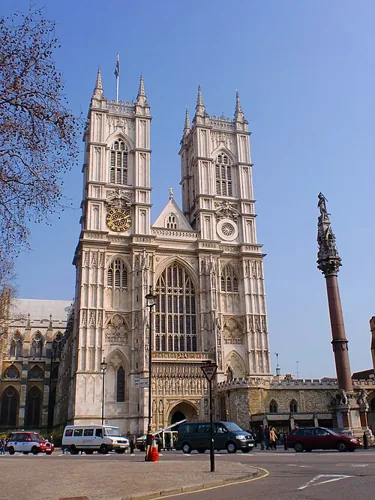
Westminster Abbey has crowned every English and British monarch since 1066 and holds the graves or memorials of about three thousand people, including seventeen sovereigns. The present Gothic church was begun by Henry III in 1245 on the site of an earlier Benedictine abbey, and the west towers were finished by Nicholas Hawksmoor in the 1740s. It is a working church rather than a museum, which is why the choir sings daily services and why parts of it close without much notice.
Open in the planner → Tours and entry ticketsGetting there
Westminster station, on the Jubilee, District and Circle lines, is five minutes away on foot along Bridge Street and across Parliament Square. St James's Park station, on the District and Circle lines, is about the same distance from the other side. From King's Cross the Victoria line to Green Park and then the Jubilee line takes roughly twenty minutes; from Waterloo it is one stop on the Jubilee line or a fifteen-minute walk over Westminster Bridge.
What you see
You normally enter by the north transept and work anticlockwise. The route takes you past the quire and the sanctuary, then up the steps to the shrine of Edward the Confessor and the Coronation Chair, which has sat here since about 1300. Behind it is the Lady Chapel built by Henry VII, with a fan-vaulted ceiling that is the single most impressive thing in the building, and the tombs of Elizabeth I and Mary, Queen of Scots in the side aisles. Coming back west you reach Poets' Corner, where Chaucer, Dickens, Hardy and Tennyson are buried and dozens more are commemorated, then the nave with the Grave of the Unknown Warrior and memorials to Newton and Darwin. The cloisters, the Chapter House and the thirteenth-century Pyx Chamber open off the south side, and the Queen's Diamond Jubilee Galleries in the medieval triforium look down the length of the nave from above.
What to pair it with
Big Ben and the Houses of Parliament are two minutes away across Parliament Square, the Churchill War Rooms are a seven-minute walk up Horse Guards Road, and St James's Park begins at the top of the same street.
When to go
The first hour after opening is by far the quietest; by late morning the nave moves at a shuffle, and summer afternoons are the worst of it. Weekdays beat weekends, and the shoulder seasons beat July and August. The abbey closes to sightseeing on Sundays and for services, state occasions and major rehearsals, but Evensong on a weekday afternoon lets you hear the choir in the quire without a sightseeing ticket, which many people prefer to the daytime visit.
What is hard about it
It is expensive by the standards of London attractions, most of which are free, and booking a timed ticket is normally needed. The interior is dense and dimly lit, the one-way route is slow, and in high season you spend a good part of the visit queueing behind other people's audio guides rather than looking at anything. Photography is restricted in much of the church. There are steps and uneven medieval flooring throughout, and the triforium galleries are reached by a lift that can be busy.
Common questions
How long do you need at Westminster Abbey?
Allow about ninety minutes for the standard route, and closer to two hours if you add the cloisters, Chapter House and the triforium galleries.
Is Westminster Abbey free?
No. Sightseeing requires a paid timed ticket, though attending a service such as Evensong or Sunday worship is free.
Can you see the Coronation Chair?
Yes, it is on display near the shrine of Edward the Confessor and is part of the normal visitor route.
Nearby
- Big Ben and the Houses of ParliamentThe Elizabeth Tower and the Palace of Westminster on the Thames
- Churchill War RoomsThe underground bunker from which Britain ran the Second World War
- Trafalgar SquareNelson's Column, the lions and the Fourth Plinth
- National GalleryWestern European painting from Van Eyck to Van Gogh, free to enter
More of the same kind
- St Paul's CathedralWren's dome, the Whispering Gallery and 528 steps to the top
- Westminster CathedralStriped Byzantine-revival Catholic cathedral with a lift up the campanile
Part of these routes
- Westminster in a dayParliament, the Abbey, the bunker under Whitehall and the royal parks, almost all on foot.
- London in three daysThe short list, ordered so each day holds together and nothing is crossed twice.
- London in five daysA fuller first visit: the centre, the City, the museums, the South Bank and a day in Greenwich.
- London at lengthEverything the other routes cover, spread over eight unhurried days with nothing rushed.