Brick Lane
Curry houses, bagel shops, vintage markets and street art
- Area Shoreditch
- Type Neighbourhood
- Time needed 1h 15m
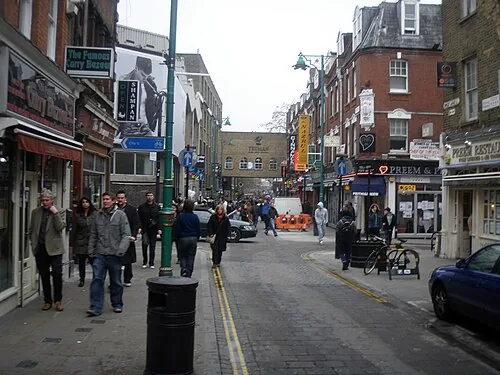
Brick Lane runs north from Whitechapel through Spitalfields into Shoreditch and has been the centre of successive immigrant communities in east London, most recently and visibly the Bangladeshi one, whose curry houses give the southern half its character. The street name has been signed in Bengali as well as English since the 1990s. The northern half, around the Old Truman Brewery, carries weekend markets, vintage clothing and the densest concentration of street art in the city. The Sunday markets are the reason most visitors come.
Open in the planner → Tours and entry ticketsGetting there
Shoreditch High Street on the Overground is the closest station to the northern end, about five minutes' walk east along Bethnal Green Road. Aldgate East, on the District and Hammersmith and City lines, serves the southern end and is a seven-minute walk north. Liverpool Street, with the Central, Circle, Metropolitan, Hammersmith and City and Elizabeth lines plus national rail, is around ten minutes' walk west and is the easiest arrival from most of London — reckon on ten to fifteen minutes to get there from the centre. Whitechapel, on the District, Hammersmith and City and Elizabeth lines, is also within ten minutes of the south end. Buses 8, 388 and 254 run along the surrounding roads.
What you see
Coming from the south you meet the curry houses first, a long run of them between Fashion Street and Hanbury Street, with waiters still soliciting from the doorways. The Brick Lane Jamme Masjid at the Fournier Street corner is worth stopping at: built as a Huguenot chapel in 1743, later a synagogue, now a mosque, with a sundial on its wall carrying the Latin inscription about shadow — one building that carries the whole history of the street. Fournier Street and Wilkes Street off to the west are lined with Georgian silk weavers' houses with wide attic windows built for the looms. Further north, the Old Truman Brewery complex spreads over both sides of the lane and holds the covered markets, with a long chimney and the old brewery frontage. The side streets here — Hanbury Street, Sclater Street, Grimsby Street and the Shoreditch end of Bethnal Green Road — carry large-scale murals that change every few months, which is the best street art viewing in London. At the top of the lane are the two long-standing twenty-four-hour bagel shops, selling salt beef and smoked salmon beigels, the surviving trace of the Jewish East End. Just west of the brewery is Spitalfields Market under its Victorian iron roof.
What to pair it with
Old Spitalfields Market is a five-minute walk west and covers for Brick Lane on the days the markets are not running. Columbia Road flower market is fifteen minutes north and also a Sunday event, which makes the two easy to combine. The Tower of London and St Katharine Docks are about twenty-five minutes' walk south, or three stops from Aldgate East.
When to go
Sunday is the day. The Sunday Upmarket and the other market halls in the Truman Brewery, the vintage sellers and the food stalls all trade together, roughly from late morning to late afternoon, and the lane is closed to through traffic for part of its length. Saturday is a reasonable second, with some of the markets open and fewer people. Friday has a smaller vintage trade. Monday to Thursday there is no real market at all: the curry houses, bagel shops, record shops and street art are all still there, and it is a much calmer walk, but anyone who came for a market will be disappointed. Evenings from Thursday onwards the Shoreditch end is busy with drinkers and loud until late. For street art, any weekday morning gives you clear pavement and sunlight on the north-facing walls.
What is hard about it
Sunday is extremely crowded and slow between about midday and three, and the market halls in particular are a crush. The curry houses on the southern stretch vary a great deal and the aggressive touting outside them puts many people off; the reputation of the street for food rests more on history than on current standards, and the bagel shops and the newer places at the north end are generally the safer choice. Pickpocketing is common in the market crowds. The lane is noisy, littered on Monday mornings and distinctly rough-edged after dark at the weekend. There is nothing to go into and no ticket, so on a quiet weekday the visit can feel like a walk down an ordinary scruffy street. Public toilets are few and the paid market ones are not always open.
Common questions
How long do you need at Brick Lane?
Around seventy-five minutes to walk the length of it, look at the street art on the side roads and stop for a beigel. Allow two to three hours on a Sunday if you want to work through the markets.
Which day is the Brick Lane market on?
Sunday is the main market day, when the Truman Brewery halls, the vintage sellers and the food stalls are all trading. Saturday is quieter with a reduced market, and there is effectively no market Monday to Thursday.
Is Brick Lane safe to walk at night?
The Shoreditch end stays busy and well lit until late, which makes it reasonably comfortable, but it gets rowdy with drinkers at weekends and the quieter southern stretch towards Whitechapel is worth avoiding alone late on.
More of the same kind
- Covent GardenThe old market building, street performers and the piazza
- Little VeniceWhere two canals meet, with narrowboats and a waterbus to Camden
- St Katharine DocksA quiet yacht marina in restored warehouses, minutes from the Tower
- Canary WharfThe second financial district, towers over the old West India Docks