Covent Garden
The old market building, street performers and the piazza
- Area Covent Garden
- Type Neighbourhood
- Time needed 1h
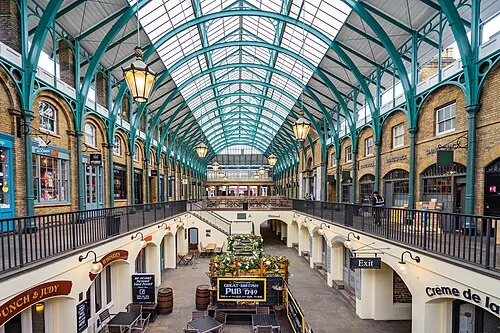
Covent Garden was London's fruit and vegetable market from the seventeenth century until 1974, when the trade moved to Nine Elms and Charles Fowler's 1830 market building was converted to shops. The piazza around it was laid out by Inigo Jones in the 1630s as London's first formal square. The licensed street performers in the piazza and the lower courtyard are a continuous tradition rather than an occasional event.
Open in the planner → Tours and entry ticketsGetting there
Covent Garden station, on the Piccadilly line, is two minutes from the piazza but is one of the busiest small stations on the network, with lifts only and frequent exit-only restrictions. Leicester Square, on the Northern and Piccadilly lines, is a five-minute walk and almost always the better choice; Charing Cross and Embankment are each about eight minutes to the south, adding the Bakerloo, District and Circle lines and rail services. Holborn, on the Central and Piccadilly lines, is ten minutes from the north-east side.
What you see
The Apple Market under the glass roof of the central building holds craft and antique stalls, with the day of the week deciding what is on; the East Colonnade and Jubilee Market halls sit either side. Below the north end, the lower courtyard is where the classical musicians play to people on the surrounding balconies, and the main street acts work the open piazza outside. St Paul's Church on the west side is the one Inigo Jones built, with its portico the setting for the opening of Pygmalion. The Royal Opera House occupies the north-east corner, with a foyer and daytime tours, and the London Transport Museum fills the old flower market on the east side. Neal's Yard, a small painted courtyard, is five minutes north through Seven Dials, and the streets around — Floral Street, Monmouth Street, Long Acre — are the actual shopping.
What to pair it with
Somerset House is an eight-minute walk south-east along the Strand, Trafalgar Square is ten minutes south-west, and Piccadilly Circus is about fifteen minutes west through Soho.
When to go
Before ten in the morning the piazza is almost empty and the market building is worth seeing without the crowd. Performers are on from late morning until evening, with the best acts in the afternoon. Weekend afternoons are solidly packed, and December, when the piazza is decorated and lit, is both the prettiest and the most crowded time of year. Evenings are good: the theatre crowd arrives, the lighting flatters the colonnades, and the stalls have gone.
What is hard about it
It is a tourist market, and the prices in the halls reflect that rather than any bargain. The piazza is one of the more congested spots in central London, and in bad weather there is little cover outside the market building itself. Covent Garden station is small enough that queues to use the lifts spill onto the street at peak times, which is why walking from Leicester Square is advised. Street performances draw tight rings of people that block the paths, and the restaurants immediately on the piazza are generally worse and dearer than the ones a street away.
Common questions
How long do you need at Covent Garden?
An hour to walk the piazza, the market halls and a couple of the side streets. Longer if you add the Transport Museum or stop to eat.
Is there a market every day?
Yes, the Apple Market and Jubilee Market run daily, but the stallholders change by day, with antiques on one day and crafts on others. Check before you go if you want a particular one.
Should I use Covent Garden station?
Only if you are travelling light. It has lifts rather than escalators and is often exit-only at busy times; Leicester Square is a short walk and much easier.
More of the same kind
- Little VeniceWhere two canals meet, with narrowboats and a waterbus to Camden
- Brick LaneCurry houses, bagel shops, vintage markets and street art
- St Katharine DocksA quiet yacht marina in restored warehouses, minutes from the Tower
- Canary WharfThe second financial district, towers over the old West India Docks
Part of these routes
- Bloomsbury and the galleriesThe British Museum at opening time, then paintings at Trafalgar Square and Millbank.
- West End on footAn afternoon and evening between the lit junction, the piazza and the river terrace.
- London in three daysThe short list, ordered so each day holds together and nothing is crossed twice.
- London in five daysA fuller first visit: the centre, the City, the museums, the South Bank and a day in Greenwich.
- London at lengthEverything the other routes cover, spread over eight unhurried days with nothing rushed.