Canary Wharf
The second financial district, towers over the old West India Docks
- Area Docklands
- Type Neighbourhood
- Time needed 1h
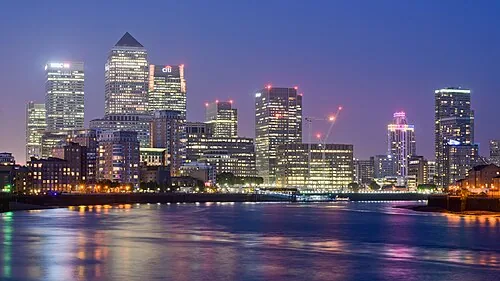
Canary Wharf is the office district built from 1988 onwards on the West India Docks on the Isle of Dogs, three miles east of the City, and now holds the greatest concentration of tall buildings in Britain. One Canada Square, the pyramid-topped tower of 1991, was the tallest building in the country for almost two decades. The docks themselves survive as water between the towers, with gardens, a roof garden over the Elizabeth line station and a large amount of covered shopping below ground. There is no attraction to buy a ticket for; what you come for is the architecture, the water and the Docklands museum nearby.
Open in the planner → Tours and entry ticketsGetting there
Canary Wharf is served by the Jubilee line, by the DLR at Canary Wharf and Heron Quays, and by the Elizabeth line at its own separate station, so it is unusually easy to reach: twelve to fifteen minutes from Waterloo or London Bridge on the Jubilee line, ten minutes from Liverpool Street on the Elizabeth line. The DLR from Bank or Tower Gateway takes a little longer but runs above ground past the docks and is much the better ride, especially from the front of the train. Thames Clipper boats call at Canary Wharf Pier from Westminster, Tower and Greenwich, which is the most enjoyable approach. The three stations are a few minutes' walk apart and the whole estate is walkable, with underground malls linking the towers in bad weather.
What you see
Come up at Canary Wharf DLR and you are above the water on the old quay; Cabot Square, west of One Canada Square, has the large circular fountain and the clearest view up the sides of the towers. One Canada Square itself has a public lobby of Italian marble but no viewing platform, so the tower is something you look at rather than go up. Crossrail Place Roof Garden, the timber-latticed enclosure over the Elizabeth line station, is planted with species from the hemispheres the Isle of Dogs ships traded with and is the single best thing on the estate, free and usually quiet. Jubilee Park, between the towers on top of the Jubilee line station, has mature trees and a serpentine water channel. The old dock walls and the swing bridges at Wood Wharf and West India Quay are the remaining physical evidence of the port. North across the water at West India Quay is a surviving Georgian sugar warehouse of 1802 that holds the Museum of London Docklands, free to enter, which tells the story of the port, slavery and the river over several floors — this is the serious content in the area. There is a good deal of public sculpture around the squares, and the Jubilee line station by Norman Foster, a vast concrete box with a curved glass canopy, is worth going down into for its own sake.
What to pair it with
The Museum of London Docklands at West India Quay is a five-minute walk north and should really be treated as part of the same visit. Greenwich is a short ride on the DLR to Cutty Sark or a walk through the Greenwich Foot Tunnel from Island Gardens at the south of the Isle of Dogs, which gives the classic view back across the river. The Thames Path and Limehouse Basin lie west towards Wapping.
When to go
Weekday mornings and lunchtimes are when the district is doing what it was built for, with tens of thousands of people moving through the squares, and it is at its most interesting then. Weekends are strikingly empty: good for photography and the roof garden, dull if you wanted atmosphere, and some of the food outlets close. Dusk on a clear evening is the best time for the towers, with the glass lit from inside. Winter sees an ice rink and lights in the squares. Summer brings outdoor events and the water-sports centre on the dock.
What is hard about it
This is a business district, and if you are not interested in tall buildings there is not much reason to be here. The public realm is privately owned and managed, which in practice means security staff who will stop you using a tripod or a drone and signs about where you may not sit. No tower here has a public viewing deck. The underground shopping malls are large, repetitive chains and confusing to navigate, and the signage between the three stations is poor. Food is plentiful but mostly chains at City prices, and much of it shuts at the weekend. Wind between the towers is genuinely strong and unpleasant in winter. The free Museum of London Docklands is the best thing in the area and is often missed because it is a few minutes outside the estate.
Common questions
How long do you need at Canary Wharf?
An hour covers Cabot Square, the roof garden, Jubilee Park and the dock edges. Add an hour and a half if you include the Museum of London Docklands.
Can you go up a tower at Canary Wharf?
No. None of the towers, including One Canada Square, has a public observation deck; for a high view from east London use the cable car at Royal Docks or the Shard further west.
Is Canary Wharf worth visiting at the weekend?
Only for the architecture and the roof garden, which are better without the crowds. The district is largely deserted and a number of shops and restaurants close, so weekdays show it at its most alive.
More of the same kind
- Covent GardenThe old market building, street performers and the piazza
- Little VeniceWhere two canals meet, with narrowboats and a waterbus to Camden
- Brick LaneCurry houses, bagel shops, vintage markets and street art
- St Katharine DocksA quiet yacht marina in restored warehouses, minutes from the Tower