Buckingham Palace
The monarch's London residence, with the Changing of the Guard outside
- Area St James's
- Type Palace
- Time needed 1h
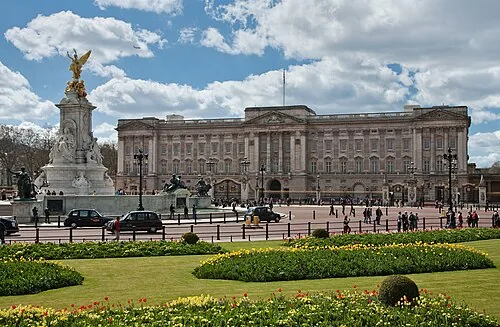
Buckingham Palace has been the official London residence of the monarch since 1837, when Victoria moved in, and has 775 rooms behind the east front that faces the Victoria Memorial. The building most people photograph is the facade of 1913; the older house by John Nash is behind it. For most of the year the interest is entirely outside the railings, and the Changing of the Guard is the reason the crowd is there.
Open in the planner → Tours and entry ticketsGetting there
Green Park station, on the Piccadilly, Victoria and Jubilee lines, is the easiest approach: leave by the Buckingham Palace exit and walk ten minutes down Constitution Hill. St James's Park station, on the District and Circle lines, is a similar walk from the other direction, and Victoria station, with rail services plus the Victoria, District and Circle lines, is about twelve minutes away up Buckingham Palace Road. From the West End it is fifteen minutes or so on the Underground, and the walk from Trafalgar Square through St James's Park takes around twenty-five minutes and is better than the train.
What you see
From the Victoria Memorial you see the full east front and the central balcony used for state occasions, with the Royal Standard flying when the monarch is in residence and the Union Flag when not. The guard on duty stands at the forecourt sentry boxes; the Changing of the Guard involves detachments marching between here, St James's Palace and Wellington Barracks with a band, so the procession along The Mall and Spur Road is often a better watch than the forecourt itself. In the summer opening the State Rooms are shown on a route that normally includes the Grand Staircase, the Throne Room, the Picture Gallery hung with works from the Royal Collection, the Ballroom and the State Dining Room, ending with the garden walk along the west terrace. The King's Gallery alongside the palace shows changing exhibitions from the Royal Collection all year, and the Royal Mews houses the state coaches and carriage horses.
What to pair it with
St James's Park is immediately east of the forecourt, Green Park is immediately north, and Westminster Abbey is a twenty-minute walk along Birdcage Walk.
When to go
For the Changing of the Guard, be at the railings or on the Victoria Memorial steps a good forty-five minutes early; the ceremony runs on set days that vary with the season and is cancelled in bad weather, so check the day before. The State Rooms open only for a limited period in late summer and occasionally in winter, with timed tickets that go quickly. Mornings are busiest; by late afternoon the forecourt is calm and the low sun on the east front is the best light of the day.
What is hard about it
The palace is closed to visitors for most of the year, and people who turn up expecting to go in are regularly disappointed. The Changing of the Guard is viewed from behind railings in a dense, slow-moving crowd where the short cannot see much, and the ceremony is long and largely static. Summer State Room tickets are costly, timed, non-flexible and cover a single route with no re-entry, and photography inside is not allowed. There is very little shelter on the forecourt approach when it rains.
Common questions
How long do you need at Buckingham Palace?
About an hour outside, including waiting for the guard. The summer State Rooms tour takes two to two and a half hours with the garden.
Can you go inside Buckingham Palace?
Only during the limited State Rooms opening, mainly in late summer, with timed tickets booked in advance. The King's Gallery and the Royal Mews are open far more of the year.
Is the Changing of the Guard worth seeing?
It is a genuine military ceremony with a band, but it is crowded and slow. Watching the detachment march along The Mall or past Wellington Barracks is often the better view.
Nearby
More of the same kind
- Kensington PalaceRoyal residence with state apartments and the sunken garden
- Hampton Court PalaceHenry VIII's Tudor palace with Wren additions, gardens and the maze
- Eltham PalaceMedieval great hall bolted onto a spectacular 1930s art deco house
Part of these routes
- Westminster in a dayParliament, the Abbey, the bunker under Whitehall and the royal parks, almost all on foot.
- Palaces and parksTwo working royal residences, the gardens between them and the striped cathedral in Victoria.
- London in three daysThe short list, ordered so each day holds together and nothing is crossed twice.
- London in five daysA fuller first visit: the centre, the City, the museums, the South Bank and a day in Greenwich.
- London at lengthEverything the other routes cover, spread over eight unhurried days with nothing rushed.