Hampton Court Palace
Henry VIII's Tudor palace with Wren additions, gardens and the maze
- Area Richmond upon Thames
- Type Palace
- Time needed 3h
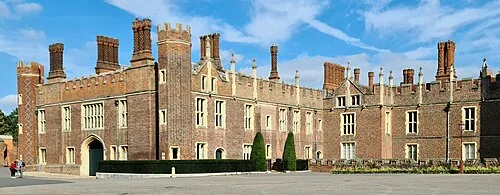
Hampton Court Palace stands on the Thames about twelve miles south-west of central London and is effectively two palaces joined together: Henry VIII's Tudor brick courtyards, taken over from Cardinal Wolsey in 1529, and the baroque range Christopher Wren built for William and Mary in the 1690s when they ran out of money to demolish the rest. Sixty acres of formal gardens sit behind it, including the hedge maze planted around 1700 and the Great Vine of 1768. It has not been a royal residence since the eighteenth century.
Open in the planner → Tours and entry ticketsGetting there
Hampton Court station is on the National Rail line out of London Waterloo, about thirty-five minutes direct or with one change at Surbiton, and the palace gates are a five-minute walk across Hampton Court Bridge from the station — you can see the building from the platform. There is no Underground station anywhere near; anyone searching for one is looking for Hampton Court on the wrong network. From Richmond or Kingston a bus runs along the river, and in summer a riverboat comes up from Westminster, which takes several hours and is a day out in itself rather than a way of getting there. Driving is possible but the car park fills.
What you see
You come in through the Tudor west front and Base Court, then under Anne Boleyn's Gateway with its astronomical clock of 1540 into Clock Court. From there the routes split and it is worth taking them in order. Henry VIII's Great Hall is the set piece: a hammerbeam roof, Flemish tapestries of the story of Abraham bought by Henry himself, and a minstrels' gallery. Beyond it the Great Watching Chamber, the Chapel Royal with its blue and gold vaulted ceiling, and the Tudor kitchens, which are kept as working rooms with fires lit and food being prepared, smoky and far more convincing than most reconstructions. The Haunted Gallery runs off the Tudor side. Wren's half is a different world: the King's Apartments climb a painted staircase into a sequence of state rooms ending at the bed, while Queen Mary's rooms and the Cumberland Art Gallery hold paintings from the Royal Collection. Outside, the Privy Garden has been restored to its 1702 planting, the Great Vine still produces grapes under glass, and the Maze is a half-acre of clipped yew and hornbeam that takes most people twenty minutes to get wrong. The Royal Tennis Court, where a version of the real tennis Henry played is still played, is open on the way round.
What to pair it with
Richmond Park is a short train ride or a long riverside walk north. Kew Gardens is on the same side of London and reachable the same day if you start early. Richmond town is a convenient stop on the way back.
When to go
Spring and early summer for the gardens, when the Privy Garden planting and the long borders are at their best. The palace itself is best in winter, when it is quiet, the Tudor kitchen fires are the warmest place in the building and you can stand alone in the Great Hall. Weekday mornings right at opening are the calmest; weekends, school holidays and the garden festival period in July are heavy. Allow a full morning or afternoon rather than squeezing it between other things, because the journey each way eats an hour.
What is hard about it
It is a long way out and the trip swallows a good two hours of travel in total. The palace is ticketed, not cheap, and booking a timed slot ahead is normally expected and often cheaper. Inside there are a great many stairs, including the main approaches to both the Tudor and the Wren apartments, and while much of the ground floor and the gardens are accessible, the upper state rooms are a problem for anyone who cannot manage steps. The sheer quantity of rooms wears people down and the two architectural halves can start to blur. The Maze is small and lightly disappointing if you expect something taller than head height. Parts of the gardens and individual rooms close for conservation without much notice, and the Great Vine is only in leaf part of the year, so check before you go.
Common questions
How long do you need at Hampton Court Palace?
Three hours is the working minimum for the Tudor rooms, the Wren apartments and a quick look at the gardens. Four or five if you want the Maze, the Privy Garden and the kitchens properly.
How do you get to Hampton Court from London?
Train from London Waterloo to Hampton Court station, roughly thirty-five minutes, then a five-minute walk over the bridge. There is no Underground service.
Is the Maze included in the ticket?
The Maze is inside the garden area and normally covered by a full palace ticket, though gardens-only tickets also exist. Check before you go, as the combinations change.
More of the same kind
- Buckingham PalaceThe monarch's London residence, with the Changing of the Guard outside
- Kensington PalaceRoyal residence with state apartments and the sunken garden
- Eltham PalaceMedieval great hall bolted onto a spectacular 1930s art deco house