Eltham Palace
Medieval great hall bolted onto a spectacular 1930s art deco house
- Area Eltham
- Type Palace
- Time needed 2h
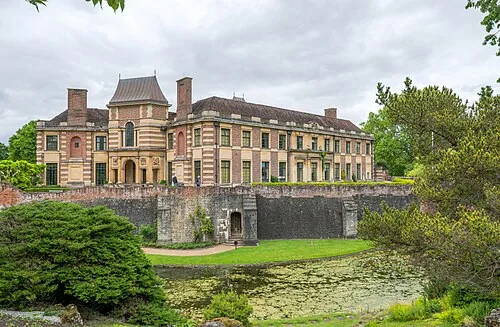
Eltham Palace in south-east London is two buildings in one enclosure: the surviving fifteenth-century great hall of a medieval royal palace where Henry VIII spent much of his childhood, and an art deco country house built alongside it in 1933 and 1936 for the textile heirs Stephen and Virginia Courtauld. The Courtaulds leased the ruined site, restored the hall and commissioned a modern house whose interiors are among the best preserved 1930s rooms in Britain. It is run by English Heritage and is one of the least visited major sites inside Greater London.
Open in the planner → Tours and entry ticketsGetting there
This one is National Rail, not Underground. Mottingham station, on the line from London Charing Cross and London Cannon Street via Lewisham, is about twenty-five to thirty-five minutes out and a fifteen-minute walk from the palace. Eltham station, on the line from Charing Cross and Cannon Street via Blackheath, is a similar distance on foot up Court Yard. There is no tube anywhere close. If you are coming from the Greenwich direction the DLR to Lewisham with a change onto the rail service works, and buses run to Eltham High Street from Greenwich and Woolwich.
What you see
You come in across a medieval stone bridge over the dry moat, which is the oldest working bridge in London. The entrance hall of the Courtauld house sets the tone immediately: a circular room under a concrete and glass dome, with marquetry panels by the Swedish designer Rolf Engstromer showing Italian and Scandinavian scenes, and curved blackbean veneer walls. Virginia Courtauld's bedroom and bathroom are the high points — the bathroom lined in gold mosaic with onyx and a statue of Psyche in a niche, as extravagant as anything of its decade in the country. Stephen's study, the dining room with its aluminium-leaf ceiling and black and silver doors, and the leather-panelled drawing room follow. There is also a heated cage built into the house for Mah-Jongg, the Courtaulds' pet ring-tailed lemur, with a bamboo ladder down to the flower room. Then you walk into the great hall, a vast fifteenth-century room with a false hammerbeam roof of the 1470s, which the Courtaulds used as a music room and furnished with a minstrels' gallery. Nineteen acres of gardens outside hold a sunken rose garden, long borders and the medieval moat walls, and there are 1930s service rooms, a map room and a wartime bunker beneath the house.
What to pair it with
Greenwich is the obvious combination — the Royal Observatory, the National Maritime Museum and the Cutty Sark are twenty minutes away on the same rail corridor. Greenwich Park goes with them. Canary Wharf is a short DLR ride beyond if you want to end somewhere modern.
When to go
Spring and summer for the gardens, which are a real part of the visit and account for half the site. The house itself is best on a weekday, when you can have the entrance hall and Virginia's bathroom to yourself — this is a quiet site even at peak times, which is its great advantage over the central palaces. Opening is seasonal and reduced in winter, often to a few days a week, so check before you go rather than turning up in January. Late afternoon light through the dome in the entrance hall is the one thing worth timing for.
What is hard about it
It is ticketed and the journey out is longer than the distance suggests, with a walk at the far end from either station. Opening days are limited, particularly from autumn to spring, and people arrive to find it shut — this is the most common complaint about the place. The house is not large; the interiors are extraordinary but you can walk the lot in under an hour, and some visitors feel the ticket price is steep for the floor area. The medieval palace is largely gone: the great hall survives and some walls, but anyone expecting a Tudor palace will be disappointed. There are stairs to the bedroom floor, and the basement rooms involve more. The surrounding area is ordinary suburb, so there is nothing much to do nearby if the timing goes wrong.
Common questions
How long do you need at Eltham Palace?
Two hours is about right: an hour for the house and great hall, another for the gardens and the moat walk. Less in winter when the gardens are bare.
Is Eltham Palace on the Underground?
No. It is National Rail from Charing Cross or Cannon Street to either Mottingham or Eltham, then about fifteen minutes on foot.
Is it worth visiting if you are not interested in art deco?
The great hall and the gardens stand on their own, but the 1930s interiors are the reason most people make the journey. If modern design leaves you cold, Hampton Court is the better trip.
More of the same kind
- Buckingham PalaceThe monarch's London residence, with the Changing of the Guard outside
- Kensington PalaceRoyal residence with state apartments and the sunken garden
- Hampton Court PalaceHenry VIII's Tudor palace with Wren additions, gardens and the maze