Highgate Cemetery
Overgrown Victorian necropolis, Egyptian Avenue, and Marx's tomb
- Area Highgate
- Type Landmark
- Time needed 1h 15m
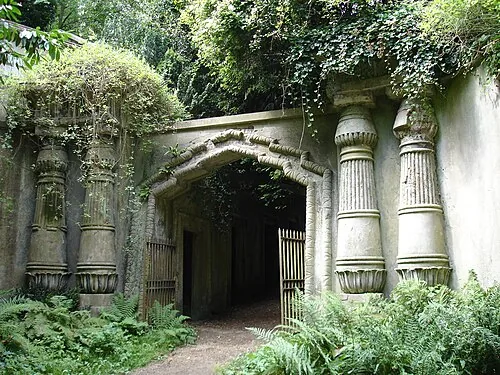
Highgate Cemetery opened in 1839 as a commercial burial ground for a city whose parish churchyards had run out of room, and it holds around 170,000 burials across two sites divided by Swain's Lane in north London. The older West side is a half-collapsed Victorian landscape of vaults and overgrown monuments, including the Egyptian Avenue and the Circle of Lebanon. The East side, opened in 1854, contains the tomb of Karl Marx and is the half most visitors come for. Both sides are ticketed, and the West side can normally only be seen on a guided tour.
Open in the planner → Tours and entry ticketsGetting there
Archway is the nearest Underground station, on the Northern line High Barnet branch, about twenty minutes from King's Cross, and from there it is a fifteen-minute walk uphill through Waterlow Park to the cemetery gates — the steepest approach, but the most pleasant. Highgate station, one stop further north on the same branch, is a similar distance and comes downhill to the gates instead, which most people prefer on the way there. Buses along Highgate Hill stop near the top of Swain's Lane. Gospel Oak on the Overground is about twenty-five minutes on foot across the edge of Hampstead Heath if you are combining the two.
What you see
On the East side you walk gravel paths between dense Victorian and twentieth-century headstones under heavy tree cover. Marx's tomb is the obvious destination, a large bronze head on a stone plinth erected in 1956, usually with flowers at its base; the novelist George Eliot lies nearby under the name Mary Ann Cross, and the ground around holds a scattering of later radicals, writers and exiles. The West side is the extraordinary one. The guided route takes you up through the Egyptian Avenue, a sunken passage of vaults behind an arch of lotus columns, into the Circle of Lebanon, a ring of tomb doorways dug around a cedar tree that predates the cemetery, and past the Terrace Catacombs. Ivy, brambles and self-seeded ash have been allowed to half-swallow the monuments, and broken angels and draped urns lean out of the undergrowth. The guide will point out the symbolism — the inverted torch, the draped urn, the broken column for a life cut short — which you would otherwise walk past.
What to pair it with
Hampstead Heath runs up to the cemetery's western edge, and Parliament Hill is a walk of about half an hour from the gates. Waterlow Park is immediately next door and free. Camden Market is a short ride back down the Northern line if you want somewhere busy to end the day.
When to go
Morning visits are quieter and the light angles down through the trees onto the West side monuments, which is what the place looks like in every photograph you have seen of it. Winter and early spring strip the leaf cover and let you actually see the architecture of the tombs; by midsummer the vegetation has closed over and you are looking at green walls. Weekends are busy and the West side tours fill first. Rain makes the paths slick but the atmosphere considerably better.
What is hard about it
Both sides are ticketed and the West side is normally tour-only, which means you cannot simply wander it — tours run to a timetable, go at the guide's pace and need booking ahead, especially at weekends. Check before you go, because arrangements and tour availability change. The ground is steep, the paths are uneven gravel and worn stone, and there are steps and slopes that rule out wheelchairs and make it hard going with a pushchair or a bad knee. Photography rules vary by side and by tour. Some visitors find the Marx tomb an anticlimax after the walk uphill: it is a monument in a tidy row, not a ruin. This is a working burial ground with funerals, so parts can be closed off at short notice.
Common questions
How long do you need at Highgate Cemetery?
Allow an hour and a quarter for both sides if you keep moving. A West side tour alone typically runs over an hour, and the East side needs thirty to forty-five minutes on top.
Can you visit the West side without a tour?
Not normally — the West side is generally accessible only on a guided tour, which needs booking in advance. The East side can usually be walked unaccompanied with a ticket.
Where is Karl Marx buried?
In the East cemetery, signposted from the entrance, under a large bronze bust on a stone plinth. It is a five-minute walk from the gate.
More of the same kind
- Big Ben and the Houses of ParliamentThe Elizabeth Tower and the Palace of Westminster on the Thames
- Trafalgar SquareNelson's Column, the lions and the Fourth Plinth
- Somerset HouseNeoclassical courtyard with fountains, ice rink in winter, galleries inside
- Piccadilly CircusThe lit advertising screens, Eros and the junction of five streets