Somerset House
Neoclassical courtyard with fountains, ice rink in winter, galleries inside
- Area Strand
- Type Landmark
- Time needed 1h
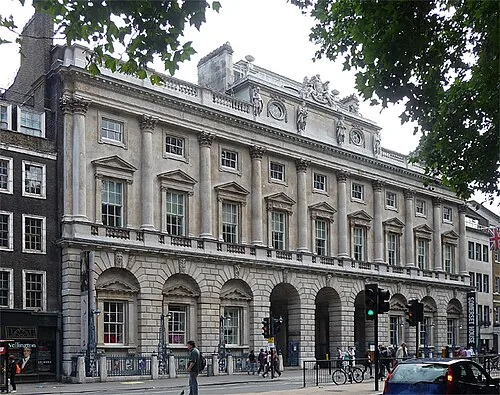
Somerset House is the large neoclassical quadrangle on the Strand, built by William Chambers from 1776 on the site of a Tudor palace to house government offices including the Navy Board and, later, the registry of births, marriages and deaths. The 55-metre courtyard was a car park until 2000, when it was cleared and fitted with 55 water jets. It now runs as an arts centre, with the Courtauld Gallery in the north wing and exhibitions, studios and events through the rest of the building.
Open in the planner → Tours and entry ticketsGetting there
Temple station, on the District and Circle lines, is three minutes east along the Strand, though it is closed on Sundays. Covent Garden, on the Piccadilly line, is eight minutes north; Embankment, with the District, Circle, Northern and Bakerloo lines, is six minutes west and also a riverboat pier; Charing Cross adds rail services ten minutes away. Waterloo is a fifteen-minute walk across Waterloo Bridge, which is the best approach for the view. The main entrance is the arch on the Strand; there is also a river-level entrance on Victoria Embankment.
What you see
Through the Strand arch you come straight into the Edmond J. Safra Fountain Court, with the fountains playing in a grid across the stone and the four ranges rising around it. The Courtauld Gallery, reached from the north wing, is the main thing to see inside: a compact collection strong in Impressionist and Post-Impressionist painting, with Manet's Bar at the Folies-Bergere, Van Gogh's Self-Portrait with Bandaged Ear, Cezanne, Degas and Gauguin, plus earlier rooms with Cranach, Rubens and Bruegel. The South Wing galleries carry changing exhibitions of photography, design and contemporary art, often free. Walk through to the River Terrace for a long view across the Thames to the South Bank and along to the City. The Embankment Building Galleries and the Deadhouse, a vaulted underground passage with old gravestones set in the walls, are opened for tours and events rather than on demand.
What to pair it with
Covent Garden is eight minutes north, Trafalgar Square is about twelve minutes west along the Strand, and the South Bank is ten minutes over Waterloo Bridge.
When to go
The courtyard is open daily and free to walk into, and it is at its best in the morning when the fountains run against a low sun and almost nobody is there. In summer the jets become a paddling ground for children by the afternoon, and open-air concerts and film screenings take over the court on some evenings. From roughly late November to January the fountains are replaced by an ice rink, which is handsome at night and fully booked at weekends. Autumn and winter weekday afternoons are the quietest for the galleries.
What is hard about it
There is less to do here than the scale of the building suggests. The Courtauld is a paid, ticketed gallery and is small for the money if you are expecting a national collection, and it has limited capacity in its upper rooms. The courtyard, which is the free attraction, is largely empty when the fountains or the rink are not running, and in the changeover weeks you may find a fenced building site. Most of the historic interiors are not open to general visitors. Temple station is shut on Sundays, which catches people out, and the ice rink needs booking well ahead.
Common questions
How long do you need at Somerset House?
About an hour for the courtyard, the River Terrace and one exhibition. Add ninety minutes if you are doing the Courtauld properly.
Is Somerset House free?
The courtyard, the River Terrace and some of the South Wing exhibitions are free. The Courtauld Gallery and the larger shows are ticketed.
Is the ice rink there all year?
No. It runs for a winter season only, roughly from late November into January, and the fountains return afterwards.
More of the same kind
- Big Ben and the Houses of ParliamentThe Elizabeth Tower and the Palace of Westminster on the Thames
- Trafalgar SquareNelson's Column, the lions and the Fourth Plinth
- Piccadilly CircusThe lit advertising screens, Eros and the junction of five streets
- Tower BridgeThe Victorian bascule bridge, with a glass walkway between the towers
Part of these routes
- Bloomsbury and the galleriesThe British Museum at opening time, then paintings at Trafalgar Square and Millbank.
- West End on footAn afternoon and evening between the lit junction, the piazza and the river terrace.
- London in five daysA fuller first visit: the centre, the City, the museums, the South Bank and a day in Greenwich.
- London at lengthEverything the other routes cover, spread over eight unhurried days with nothing rushed.