Trafalgar Square
Nelson's Column, the lions and the Fourth Plinth
- Area Westminster
- Type Landmark
- Time needed 30m
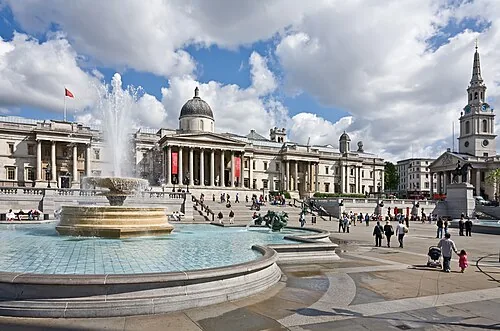
Trafalgar Square was laid out in the 1840s to commemorate the naval victory of 1805, and Nelson's Column at its centre stands about 52 metres high with the admiral on top. Edwin Landseer's four bronze lions were added in 1867, and the north-west plinth, left empty for want of funds, has carried a rotating series of commissioned sculptures since 1999. It is the square London uses for everything: rallies, Christmas trees, New Year, and large numbers of people sitting on steps.
Open in the planner → Tours and entry ticketsGetting there
Charing Cross station is at the south-east corner, served by the Northern and Bakerloo lines and by South Eastern rail services from Kent and south-east London. Leicester Square, on the Northern and Piccadilly lines, is four minutes north; Embankment, on the District, Circle, Northern and Bakerloo lines, is five minutes south and also a riverboat pier. Almost every central bus route passes one side of it. From most of the West End it is a walk rather than a journey.
What you see
Come in from the south side and the square rises in front of you: the column, the lions at its base, and the National Gallery's long Wilkins facade closing the north end above the terrace steps. Walk up to the terrace for the view back down Whitehall, with the Elizabeth Tower lined up at the end of it, which is the best single sightline in the square. The Fourth Plinth is on your left as you face the gallery, and whatever is on it is usually worth five minutes. Two fountains sit either side of the column, the bronze reliefs around its base are cast from captured French guns, and the small plinth in the south-east corner carries a statue of George IV. Behind the terrace, St Martin-in-the-Fields sits on the north-east corner with a cafe in its crypt, and Admiralty Arch frames the start of The Mall to the south-west.
What to pair it with
The National Gallery is directly on the square, Piccadilly Circus is a ten-minute walk up the Haymarket, and Covent Garden is about ten minutes north-east.
When to go
Seven or eight in the morning is the only time the square is quiet, and the light then comes across the column from the east. Evenings are busy but pleasant, with the gallery lit and the fountains on. It is heavily used for protests, concerts, festivals and public screenings, particularly at weekends, and the whole square is sometimes fenced off for staging, so if you want it empty, come on a weekday morning out of season.
What is hard about it
There is not a great deal to do once you have looked at it; twenty minutes is honest. It is loud, exposed, full of pigeons and heavily policed, the steps are a well-known spot for pickpocketing, and the fountains are usually cordoned in a way that keeps you further back than the photographs suggest. Climbing on the lions is popular and genuinely risky, and the column itself cannot be ascended. On event days the sound systems make conversation difficult.
Common questions
How long do you need at Trafalgar Square?
Twenty to thirty minutes, unless you go into the National Gallery or St Martin-in-the-Fields, which share the same corner.
What is on the Fourth Plinth?
A commissioned contemporary sculpture that changes every couple of years, so it depends when you visit. It is the empty-looking plinth at the north-west corner.
Can you climb Nelson's Column?
No. There is no public access to the column; people sit on the base and the lions instead.
Nearby
- Big Ben and the Houses of ParliamentThe Elizabeth Tower and the Palace of Westminster on the Thames
- Westminster AbbeyCoronation church since 1066, and burial place of monarchs and poets
- Churchill War RoomsThe underground bunker from which Britain ran the Second World War
- National GalleryWestern European painting from Van Eyck to Van Gogh, free to enter
More of the same kind
- Somerset HouseNeoclassical courtyard with fountains, ice rink in winter, galleries inside
- Piccadilly CircusThe lit advertising screens, Eros and the junction of five streets
- Tower BridgeThe Victorian bascule bridge, with a glass walkway between the towers
- Monument to the Great FireWren's column, 311 steps, built where the 1666 fire began
Part of these routes
- Westminster in a dayParliament, the Abbey, the bunker under Whitehall and the royal parks, almost all on foot.
- West End on footAn afternoon and evening between the lit junction, the piazza and the river terrace.
- London in three daysThe short list, ordered so each day holds together and nothing is crossed twice.
- London in five daysA fuller first visit: the centre, the City, the museums, the South Bank and a day in Greenwich.
- London at lengthEverything the other routes cover, spread over eight unhurried days with nothing rushed.