Tower Bridge
The Victorian bascule bridge, with a glass walkway between the towers
- Area City
- Type Landmark
- Time needed 1h
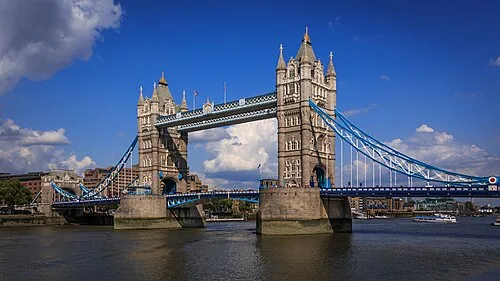
Tower Bridge opened in 1894 and is a bascule bridge, meaning the two road decks lift to let tall vessels through. It crosses the Thames immediately east of the Tower of London, and the two Gothic towers exist to house the machinery and the high-level walkways. The paid exhibition takes you up one tower, across the walkways with a section of glass floor, and down to the Victorian engine rooms on the south bank. Visitors regularly confuse it with London Bridge, which is the plain concrete crossing upstream.
Open in the planner → Tours and entry ticketsGetting there
Tower Hill (Circle and District lines) is five minutes from the north end, and Tower Gateway on the DLR about the same. London Bridge (Jubilee and Northern lines, plus national rail) is a ten-minute walk from the south end along the riverside path. Bermondsey (Jubilee) is further but quieter. Buses cross the bridge itself along Tower Bridge Road. Reaching the bridge needs no ticket — you can walk or cycle across the road deck freely at any hour, and only the towers and walkways are charged for.
What you see
The best single view of the bridge is not from it. Walk out onto the riverside terrace by the Tower of London, or down to Shad Thames on the south side, and look back. The exhibition starts in the north tower with the history of the design and the 1880s competition to cross the river below the Pool of London, then a lift takes you to the west walkway, 42 metres above the water. From there you look upstream to the Shard, London Bridge and the City towers, and downstream to Canary Wharf. A stretch of glass floor set into the walkway lets you look straight down at the traffic and the bascules; there is a second glass section on the east walkway. You descend the south tower and cross the road to the engine rooms, where the original coal-fired steam engines, accumulators and hydraulic pumps that lifted the bridge until 1976 are preserved in place, with the driving machinery still in its chamber. Lifts happen several times a week and are published in advance; standing on the north bank to watch a bascule lift is free and more memorable than the exhibition.
What to pair it with
The Tower of London is two minutes from the north end. HMS Belfast is about eight minutes west along the south bank. Shad Thames and Butler's Wharf, with the warehouse conversions and St Saviour's Dock, are five minutes east of the south end.
When to go
Early morning or the hour before sunset give the best light, and the bridge is lit after dark. The walkways are busiest from late morning through mid-afternoon. Check the published lift times before you go and plan to be on the north bank or at Shad Thames ten minutes beforehand — the road closes and the lift takes only a few minutes. Winter evenings are good for the lit bridge, as it is dark by late afternoon.
What is hard about it
The exhibition is modest for what it costs, and some visitors feel the glass floor is the whole of it. The views from the walkways are good but lower and more restricted than from the Sky Garden or the Shard, and the glass is enclosed, so there is no open-air viewing. The walkways are narrow and get congested when a large group is moving through; photographing the glass floor without strangers in the shot is difficult. The engine rooms involve crossing the road at street level and are easy to skip by accident. If you only want to see the bridge, you do not need a ticket at all, and plenty of people pay without realising that. Lifts are not daily, and are scheduled around shipping, so you cannot assume one will happen while you are there.
Common questions
How long do you need at Tower Bridge?
About an hour for the full exhibition including the walkways and the engine rooms. Walking across the road deck and photographing the bridge from the bank takes fifteen minutes and costs nothing.
Is it free to walk across Tower Bridge?
Yes. The road and footways are a public crossing, open at all times. Only the high-level walkways, the towers and the engine rooms need a ticket.
When does the bridge lift?
Lifts are scheduled around river traffic and happen several times a week rather than daily. The times are published in advance, so check before planning your day around one.
Nearby
- St Paul's CathedralWren's dome, the Whispering Gallery and 528 steps to the top
- Tower of LondonNorman keep, Crown Jewels, ravens and nine centuries of grim history
- Monument to the Great FireWren's column, 311 steps, built where the 1666 fire began
- Sky GardenFree public garden and viewing deck at the top of the Walkie Talkie
- Leadenhall MarketOrnate Victorian arcade, painted green and maroon, quiet at weekends
- Barbican CentreBrutalist estate and arts centre, with a conservatory and raised walkways
More of the same kind
- Big Ben and the Houses of ParliamentThe Elizabeth Tower and the Palace of Westminster on the Thames
- Trafalgar SquareNelson's Column, the lions and the Fourth Plinth
- Somerset HouseNeoclassical courtyard with fountains, ice rink in winter, galleries inside
- Piccadilly CircusThe lit advertising screens, Eros and the junction of five streets
Part of these routes
- The City of LondonThe square mile: Wren's dome, the Norman keep, a Victorian arcade and a free garden in the sky.
- Docklands and the riverThe old dock basins, the Victorian bridge, the towers that replaced the warehouses.
- London in three daysThe short list, ordered so each day holds together and nothing is crossed twice.
- London in five daysA fuller first visit: the centre, the City, the museums, the South Bank and a day in Greenwich.
- London at lengthEverything the other routes cover, spread over eight unhurried days with nothing rushed.