Cutty Sark
The last tea clipper, raised on supports so you can walk beneath the hull
- Area Greenwich
- Type Museum
- Time needed 1h
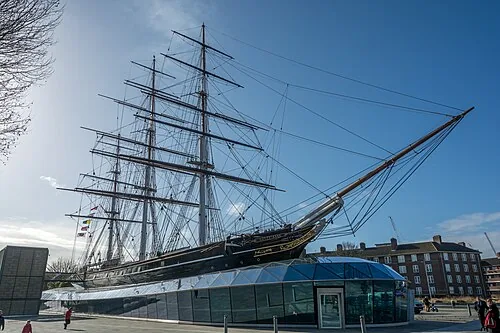
The Cutty Sark is the last surviving tea clipper, built at Dumbarton in 1869 for the China tea run and later used to carry wool from Australia, on which route she set some of the fastest passages ever made under sail. She has been in dry dock at Greenwich since 1954 and, since the restoration that followed a serious fire in 2007, has been raised about three metres on supports so that visitors can walk underneath and see the whole hull. The ship is the main survivor of the composite build — iron frames with timber planking — and is a listed vessel in the National Historic Fleet.
Open in the planner → Tours and entry ticketsGetting there
Cutty Sark on the DLR is the nearest station, about three minutes' walk: leave the station and the masts are visible immediately ahead. Greenwich station, on the DLR and on national rail from London Bridge, is around eight minutes' walk. Allow thirty to forty minutes by DLR from Bank, or roughly twelve minutes on the train from London Bridge to Greenwich. The Thames Clipper to Greenwich Pier lands you two minutes from the ship and is the best approach, taking about an hour from Westminster. The Greenwich Foot Tunnel from Island Gardens on the Isle of Dogs comes out beside the ship and is a short, odd walk under the river worth doing in itself.
What you see
Start on the weather deck, where the wheel, the deckhouses and the running rigging are laid out as they were working, and the three masts rise above you — the rig is tall enough to be worth stopping to look up at. Below on the tween deck are the cargo holds, now galleries, with tea chests, the ship's history on the China and Australia runs and material on the crews who sailed her; the curved iron frames and the planking are visible overhead and along the sides. Lower still is the hold, with more of the ship's structure exposed. The part people remember is the dry berth beneath the hull, where the ship is held up on struts and you stand under the full length of the keel looking at the copper-alloy sheathing that kept the timbers clear of weed — there is a cafe down there under the bows. Also in the dry berth is a large collection of merchant-ship figureheads, assembled in the twentieth century and displayed in rows, which is an unusual thing to see anywhere. The master's and officers' cabins at the stern have been reconstructed and furnished. Note how little space the crew had forward.
What to pair it with
The National Maritime Museum is a seven-minute walk inland and is free. The Royal Observatory is up the hill beyond it, fifteen minutes from the ship. Old Royal Naval College and the Painted Hall are two minutes east along the river front, and Greenwich Market is a minute inland.
When to go
Open all year, with timed entry. Weekday mornings early in the opening hours are the quietest; the ship fills with school groups later on weekday mornings in term time and with families at weekends and in school holidays. The decks are exposed, so a dry day makes a considerable difference. Late afternoon light on the rig from the river side is the best for photographs. The ship can be seen from the outside for nothing at any time, and the masts are floodlit in the dark months.
What is hard about it
Tickets are timed and booking is normally needed at busy times, and the price is high for a ship you can walk round in an hour — check before you go. There are a lot of steep ship's stairs between decks and the hatches are low; a lift serves the main levels but the weather deck and some areas are reached by steps only, and the gangway is narrow. Very little of what you see is original fabric: the 2007 fire destroyed a great deal, the masts and much of the planking have been renewed, and some visitors feel they are looking at a reconstruction. You cannot climb the rigging. The glass canopy that encloses the dry berth is widely disliked and makes the lower space feel more like a function room than a dock. On a wet day the weather deck is slippery and cold.
Common questions
How long do you need at the Cutty Sark?
About an hour covers the weather deck, the two lower decks and the space under the hull. Allow a little more if you want to read the cargo-hold displays properly.
Can you walk underneath the Cutty Sark?
Yes. The hull is raised on supports over a glass-covered dry berth and you can stand under the full length of the keel, which is the most striking part of the visit.
Is the Cutty Sark suitable for wheelchair users?
Partly. A lift reaches the main decks and the dry berth beneath the hull, but the weather deck and some other areas involve steps and narrow ship's ladders, so check the access information before you go.
Nearby
- Royal Observatory, GreenwichThe prime meridian, Harrison's sea clocks and the view back over the river
- National Maritime MuseumBritain at sea, including Nelson's coat from Trafalgar, free to enter
- Greenwich ParkDeer, chestnut avenues and the best skyline view in London from the hill
More of the same kind
- Churchill War RoomsThe underground bunker from which Britain ran the Second World War
- National GalleryWestern European painting from Van Eyck to Van Gogh, free to enter
- British MuseumThe Rosetta Stone, the Parthenon sculptures and eight million other objects
- HMS BelfastSecond World War cruiser moored in the Pool of London, nine decks to explore
Part of these routes
- Greenwich and the meridianA tea clipper, the naval collections, the hill with the view and the line the world sets its clocks by.
- Docklands and the riverThe old dock basins, the Victorian bridge, the towers that replaced the warehouses.
- London in five daysA fuller first visit: the centre, the City, the museums, the South Bank and a day in Greenwich.
- London at lengthEverything the other routes cover, spread over eight unhurried days with nothing rushed.