Royal Observatory, Greenwich
The prime meridian, Harrison's sea clocks and the view back over the river
- Area Greenwich
- Type Museum
- Time needed 1h 30m
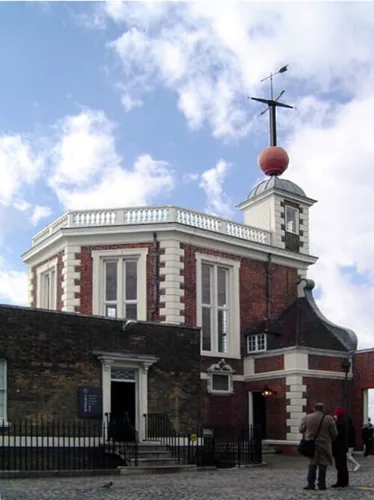
The Royal Observatory stands on the hill in Greenwich Park and was founded by Charles II in 1675 to solve the problem of finding longitude at sea. The line of zero degrees longitude — the prime meridian adopted internationally in 1884 — runs through the Airy Transit Circle in its eastern building, and the clocks John Harrison built to win the Longitude Prize are displayed here. It also holds a planetarium and the largest refracting telescope in Britain. The hilltop gives the familiar view down over the Queen's House and Canary Wharf.
Open in the planner → Tours and entry ticketsGetting there
Cutty Sark on the DLR is the usual arrival, about fifteen minutes' walk from the Observatory through the town and up the hill, which is steep at the end. Greenwich, served by the DLR and by national rail from London Bridge, is a similar distance. From central London allow thirty to forty minutes by DLR from Bank or Tower Gateway, or around twelve minutes by train from London Bridge to Greenwich. Maze Hill or Blackheath station puts you on the higher ground and avoids the climb, which is worth knowing if stairs or slopes are a problem. The Thames Clipper from Westminster, Embankment or Tower to Greenwich Pier takes an hour and is much the best way to arrive, with the Observatory visible on the hill as you come in. Buses 129, 177, 180, 188, 199 and 386 serve central Greenwich.
What you see
Flamsteed House, the red-brick building Christopher Wren designed in 1675, is the start: the Octagon Room on the first floor is the original observing room, a tall panelled space with high windows made for long telescopes, and below it are the Astronomer Royal's apartments. The Time and Longitude galleries hold Harrison's sea clocks, H1 to H3 and the watch H4, still the most interesting objects on the site — H1 to H3 are kept running and you can watch the mechanisms move. Outside in the courtyard is the meridian line itself, a brass and steel strip set in the ground with the Airy Transit Circle telescope in the building behind it, and a long queue of people photographing one foot on either side. Above, on the turret of Flamsteed House, is the red time ball that has dropped at one o'clock each day since 1833 as a signal to ships on the river. The Meridian Courtyard also carries the Shepherd Gate Clock on the outer wall, showing twenty-four hours on one dial. In the separate Great Equatorial Building, under its onion dome, sits the 28-inch refractor of 1893, one of the largest refracting telescopes in the world and still used on public evenings. The Weller Astronomy Galleries, free to enter, hold a meteorite you can touch. The Peter Harrison Planetarium, a tilted bronze cone cut into the hillside, runs live shows on a separate ticket. Step out to the terrace by the statue of General Wolfe for the view north over the park.
What to pair it with
The National Maritime Museum and the Queen's House sit at the bottom of the hill, five to ten minutes' walk down, and are free. The Cutty Sark is another five minutes beyond that towards the river. Greenwich Park itself surrounds the Observatory and the walk through it is part of the visit.
When to go
Open all year. Mid-morning on a weekday in term time is the quietest, and the meridian courtyard is at its worst between late morning and mid-afternoon at weekends and in school holidays, when the queue for a photograph on the line is long. Come for the time ball a little before one o'clock. Clear winter days give the best view down over the river, with the trees bare and the light low. Evening astronomy sessions on the 28-inch refractor run in the darker months and need booking well ahead. Allow for the hill in hot weather.
What is hard about it
The main galleries, the meridian line and the planetarium are ticketed, timed and not cheap, and booking is normally needed at busy times — check before you go. Flamsteed House is a seventeenth-century building with narrow staircases, awkward thresholds and no lift to the Octagon Room, so parts of it are inaccessible; the Astronomy Centre and planetarium side are step-free. The climb up from the town is steep and long enough to be a problem for some people, and there is no vehicle access for general visitors. The meridian courtyard is small and the queue to stand on the line is often twenty minutes for a photograph of a brass strip, which many find a poor return. The 28-inch refractor is viewed from a gallery and not looked through except on booked evenings. The site can be crowded with school groups on weekday mornings in term time.
Common questions
How long do you need at the Royal Observatory?
About ninety minutes for Flamsteed House, the Harrison clocks, the meridian courtyard and the Great Equatorial Building. Add forty minutes for a planetarium show.
Do you have to pay to stand on the prime meridian?
Yes, the brass meridian line in the Meridian Courtyard is inside the ticketed area. A continuation of the line is marked free of charge outside the courtyard wall, and there is a paving line in the park, but neither has the Airy telescope behind it.
Is the climb up to the Observatory steep?
Yes, the path up from Greenwich town rises sharply over the last few hundred metres. Arriving at Maze Hill or Blackheath station and walking in across the top of the park avoids most of the climb.
Nearby
- Cutty SarkThe last tea clipper, raised on supports so you can walk beneath the hull
- National Maritime MuseumBritain at sea, including Nelson's coat from Trafalgar, free to enter
- Greenwich ParkDeer, chestnut avenues and the best skyline view in London from the hill
More of the same kind
- Churchill War RoomsThe underground bunker from which Britain ran the Second World War
- National GalleryWestern European painting from Van Eyck to Van Gogh, free to enter
- British MuseumThe Rosetta Stone, the Parthenon sculptures and eight million other objects
- HMS BelfastSecond World War cruiser moored in the Pool of London, nine decks to explore
Part of these routes
- Greenwich and the meridianA tea clipper, the naval collections, the hill with the view and the line the world sets its clocks by.
- London in five daysA fuller first visit: the centre, the City, the museums, the South Bank and a day in Greenwich.
- London at lengthEverything the other routes cover, spread over eight unhurried days with nothing rushed.