Tower of London
Norman keep, Crown Jewels, ravens and nine centuries of grim history
- Area City
- Type Castle
- Time needed 2h 30m
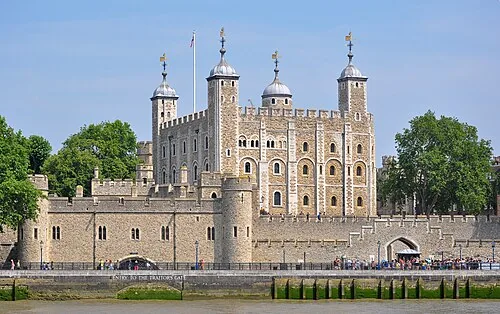
The Tower of London began as William the Conqueror's White Tower in the 1070s and has since served as fortress, palace, armoury, mint and prison. It stands on the north bank of the Thames at the eastern edge of the City, inside a double ring of walls and a dry moat. The Crown Jewels have been kept here since the seventeenth century and are the single biggest draw. It takes a half day to do properly and is one of the busiest paid attractions in the country.
Open in the planner → Tours and entry ticketsGetting there
Tower Hill (Circle and District lines) is the nearest station, about three minutes' walk down to the ticket office past the remains of the Roman wall. Tower Gateway on the DLR is a similar distance, and Fenchurch Street rail station is five minutes north. London Bridge (Jubilee and Northern lines, plus national rail) is a fifteen-minute walk across Tower Bridge, which is a far better arrival than coming up from the Underground. Riverboat services stop at Tower Pier immediately outside, and arriving by river gives you the view of the walls from the water that the building was designed to present.
What you see
You enter through the Middle Tower and along the causeway over the moat, then under the Byward Tower onto Water Lane with the walls rising on both sides. Traitors' Gate, the water entrance, is on your right. The White Tower in the centre is the oldest part and holds the Royal Armouries: Henry VIII's armour, a line of horse armour, and the Chapel of St John the Evangelist on the upper floor, a bare Norman space that is the most atmospheric room on the site. The Crown Jewels are in the Waterloo Block on the north side, reached through a sequence of rooms on the regalia and then past the crowns themselves on a moving walkway, including the Imperial State Crown and the Sovereign's Sceptre with the Cullinan I diamond. Tower Green, with its memorial to those executed within the walls, is next to the Chapel Royal of St Peter ad Vincula. The Bloody Tower has the rooms associated with Walter Raleigh's long imprisonment, and the Medieval Palace on the east side reconstructs the royal apartments of Edward I. The wall walk along the inner curtain gives views down into the inner ward and out over Tower Bridge, and the ravens are kept in the area south of the White Tower. Yeoman Warder tours run through the day from near the entrance and are included; they are the best way to get the history rather than reading boards.
What to pair it with
Tower Bridge is two minutes away and the exhibition inside it combines naturally. HMS Belfast is moored across the river, about ten minutes over the bridge. The Monument and Leadenhall Market are each fifteen minutes north-west into the City.
When to go
Get there for opening if you can. The Crown Jewels queue is shortest in the first hour and again in the last hour before closing, and is at its worst from late morning to mid-afternoon. Weekends, school holidays and cruise-ship days are heavily crowded. Winter weekdays are much more bearable, though the wall walks are exposed and cold. The site is largely outdoors, so weather matters more than at a museum.
What is hard about it
This is the most crowded major sight in London and the Crown Jewels can mean a long queue outside in the open with no shade or shelter. The moving walkway past the crowns is deliberate and means you get seconds, not minutes, with each case; people who expected to linger are often annoyed. Entry is expensive, and booking a timed slot online in advance is normally needed in season as well as cheaper. The site is large, uneven and cobbled, with narrow spiral stairs in the towers and in the wall walk, so parts are not accessible and there is a lot of walking. Signage inside the walls is poor relative to the number of visitors. Some towers and the wall walk close in bad weather or for events, and the Yeoman Warder tours do not run in heavy rain.
Common questions
How long do you need at the Tower of London?
Two and a half to three hours covers the White Tower, the Crown Jewels and a wall walk without rushing. Add an hour if you want a Yeoman Warder tour and time on Tower Green.
Do you need to book tickets in advance?
Booking a timed entry slot online is normally needed in the spring and summer and is usually cheaper than buying at the gate. Walk-up tickets exist but can mean a long wait.
What time should you arrive to avoid the Crown Jewels queue?
Arrive at opening and go straight to the Waterloo Block before anything else. The alternative is the last hour before closing, when the queue usually drops again.
Nearby
- St Paul's CathedralWren's dome, the Whispering Gallery and 528 steps to the top
- Tower BridgeThe Victorian bascule bridge, with a glass walkway between the towers
- Monument to the Great FireWren's column, 311 steps, built where the 1666 fire began
- Sky GardenFree public garden and viewing deck at the top of the Walkie Talkie
- Leadenhall MarketOrnate Victorian arcade, painted green and maroon, quiet at weekends
- Barbican CentreBrutalist estate and arts centre, with a conservatory and raised walkways
More of the same kind
Part of these routes
- The City of LondonThe square mile: Wren's dome, the Norman keep, a Victorian arcade and a free garden in the sky.
- London at warThe cabinet bunker, the museum of twentieth-century conflict and a cruiser still moored in the Pool.
- London in three daysThe short list, ordered so each day holds together and nothing is crossed twice.
- London in five daysA fuller first visit: the centre, the City, the museums, the South Bank and a day in Greenwich.
- London at lengthEverything the other routes cover, spread over eight unhurried days with nothing rushed.