Barbican Centre
Brutalist estate and arts centre, with a conservatory and raised walkways
- Area City
- Type Landmark
- Time needed 1h
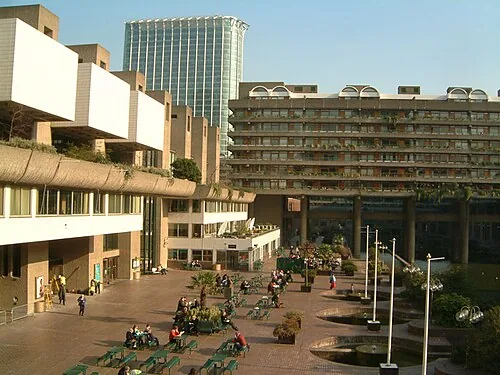
The Barbican is a residential estate and arts centre in the City, built on ground cleared by bombing in the Second World War and completed in stages between the late 1960s and 1982. It is one of the largest Brutalist complexes in Europe: three towers, long terrace blocks, a lake, raised walkways and an arts centre buried in the middle of it. The estate is Grade II listed and open to walk through for nothing; the arts centre has galleries, cinemas, two theatres and a concert hall, plus a tropical conservatory that opens on limited days. You come here for the architecture rather than for any single exhibit.
Open in the planner → Tours and entry ticketsGetting there
Barbican station (Circle, Hammersmith and City, and Metropolitan lines) is five minutes' walk, and Moorgate (the same three lines plus Northern, Elizabeth line and national rail) is about the same from the east side. St Paul's on the Central line is ten minutes south. Liverpool Street is a twelve-minute walk. From most of central London you are fifteen to twenty minutes by Underground. The signed yellow line painted on the pavement from Barbican station to the arts centre entrance exists because the estate is genuinely confusing, and following it is sensible on a first visit.
What you see
Approach along the raised highwalks rather than at street level — that is how the estate was designed to be used, and the walkway from Gilbert Bridge or from the Museum of London side gives you the scale. The concrete is pick-hammered by hand, which is what gives the surfaces their rough corduroy texture; it is worth putting a hand on. The central space is the lake terrace, with the water, the fountains and St Giles' Cripplegate — a surviving medieval church left stranded in the middle of the estate — on its north edge, alongside a stretch of the Roman and medieval city wall and a bastion. The three towers, Cromwell, Lauderdale and Shakespeare, are each 42 storeys and were briefly the tallest residential buildings in Europe. Inside the arts centre, the foyers step down over several levels with exposed concrete, original signage and the brown and orange palette largely intact; the Barbican Hall and the Barbican Theatre are off these levels. The Conservatory on the upper floors is the surprise: a large glasshouse of around two thousand species of tropical plant and trees, built over the theatre's fly tower, open to the public only on certain days and worth timing a visit around. The galleries — the main Barbican Art Gallery and the free Curve on the ground floor — run changing exhibitions on architecture, design and contemporary art.
What to pair it with
The Museum of London site and the surviving sections of the London Wall are immediately south-west. St Paul's Cathedral is a ten-minute walk south. Smithfield Market and the Charterhouse are ten minutes north-west.
When to go
Weekdays in the daytime are quiet and good for walking the highwalks and estate. Evenings before a concert or a play are the best time to see the foyers as they were meant to work, full of people on all the levels. The Conservatory opens on limited days, usually Sundays and some weekdays, and needs checking in advance; it can be booked out for private events. Overcast light flatters raw concrete more than bright sun, which blows out the texture. The lake terrace is pleasant in summer and bleak in February.
What is hard about it
The estate is notoriously hard to navigate. Levels do not connect where you expect, signage contradicts itself and arriving late for a performance because you ended up on the wrong podium level is a standard Barbican experience. Give yourself twenty minutes more than seems necessary. Much of what you can see for free is concrete walkway and residential frontage, and people who do not care about post-war architecture find it grim, grey and underwhelming — there is no view, no collection and no single thing to look at. The Conservatory is the best part and is closed most days, so a visit timed wrongly misses it entirely. Lift and stair access between podium and street level is patchy, which makes step-free routes around the estate awkward. Residents live here, so parts of the walkways and all the courtyards are private and you should not wander into them. Gallery exhibitions are ticketed and variable in quality.
Common questions
How long do you need at the Barbican?
An hour covers the highwalks, the lake terrace and the arts centre foyers. Add an hour for a gallery exhibition, or half an hour if the Conservatory is open.
Is the Barbican free to visit?
Walking the estate, the highwalks, the lake terrace and the arts centre foyers costs nothing, and the Curve gallery is normally free. The main gallery, concerts, films and theatre are ticketed.
When is the Conservatory open?
Only on limited days, most often Sundays and occasional weekdays, and sometimes closed for private hire. Check the current dates before you go, because it is the thing most worth seeing.
Nearby
- St Paul's CathedralWren's dome, the Whispering Gallery and 528 steps to the top
- Tower of LondonNorman keep, Crown Jewels, ravens and nine centuries of grim history
- Tower BridgeThe Victorian bascule bridge, with a glass walkway between the towers
- Monument to the Great FireWren's column, 311 steps, built where the 1666 fire began
- Sky GardenFree public garden and viewing deck at the top of the Walkie Talkie
- Leadenhall MarketOrnate Victorian arcade, painted green and maroon, quiet at weekends
More of the same kind
- Big Ben and the Houses of ParliamentThe Elizabeth Tower and the Palace of Westminster on the Thames
- Trafalgar SquareNelson's Column, the lions and the Fourth Plinth
- Somerset HouseNeoclassical courtyard with fountains, ice rink in winter, galleries inside
- Piccadilly CircusThe lit advertising screens, Eros and the junction of five streets