Monument to the Great Fire
Wren's column, 311 steps, built where the 1666 fire began
- Area City
- Type Landmark
- Time needed 30m
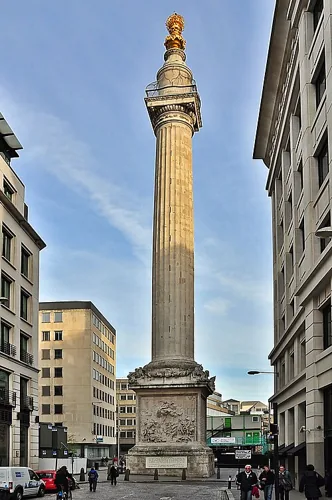
The Monument to the Great Fire of London is a fluted Doric column designed by Christopher Wren and Robert Hooke and completed in 1677, built close to the Pudding Lane bakery where the fire of 1666 started. It stands at the junction of Monument Street and Fish Street Hill in the City, and its height was set to match the distance to the seat of the fire. A spiral stair of 311 steps leads to a caged viewing platform below the gilded urn of flames. It is a short, cheap, physical stop rather than a half-hour of exhibits.
Open in the planner → Tours and entry ticketsGetting there
Monument station (Circle and District lines) is directly outside and connects underground to Bank (Central, Northern, Waterloo and City, and the DLR), so almost any central London line gets you here in fifteen minutes or so. London Bridge is a ten-minute walk south across London Bridge, which also gives you the approach view up Fish Street Hill. Cannon Street rail station is five minutes west. The column is in a tight street junction, so look up rather than expecting a square.
What you see
At street level, the carved relief on the west face by Caius Gabriel Cibber shows Charles II and his brother directing the rebuilding of the city, with a figure of London collapsed among the ruins; the Latin inscriptions on the other faces record the fire and the reconstruction. Inside, the stair is a single stone spiral of 311 steps winding around a central void, with a handrail and small windows at intervals, and it is the same width the whole way up. The platform at the top is enclosed in a mesh cage added in the 1840s after a series of suicides, and you look out at roughly 160 feet over an area now built far higher than the column. The views are therefore of the near City: the Walkie Talkie and the cluster around Bishopsgate to the north, the Shard and the river to the south, the dome of St Paul's to the west over rooftops, and down into the street pattern that survived the fire. Everyone who completes the climb is given a printed certificate at the bottom, which is more charming than it sounds.
What to pair it with
The Sky Garden is five minutes north-east and gives the open high view the Monument no longer has. Leadenhall Market is about eight minutes north. The Tower of London and Tower Bridge are both roughly fifteen minutes east along the river.
When to go
Any weekday outside the City lunch hour is fine, and it is rarely crowded enough to queue for long. Weekends are quiet at street level because the City empties, though that also means fewer places open nearby. Clear winter days give the sharpest views. The stair is unventilated and the climb is unpleasant in a summer heatwave.
What is hard about it
The 311 steps are continuous, with no landings to rest on properly and no lift, and the spiral is narrow enough that passing descending visitors on a busy day is awkward. The viewing platform is completely caged, which blocks clean photographs; you can shoot through the mesh gaps but not over it. The column is now surrounded by much taller buildings, so the view is hemmed in on most sides and nothing like a modern viewing deck. Entry is charged, modestly, and card payment only in practice. There is nothing to see inside apart from the stair, so anyone who cannot or will not climb gets nothing from a ticket. It closes in bad weather and for maintenance, and the opening season is shorter in winter.
Common questions
How long do you need at the Monument?
Half an hour is enough, including the climb up and down and a few minutes at the top. Looking at the column and its carvings from the street takes five.
How hard is the climb?
311 steps in one continuous narrow spiral with no lift and nowhere real to stop. Most reasonably fit adults manage it in about seven minutes but arrive at the top out of breath.
Is the view worth it compared with the Sky Garden?
No, if the view is all you want — the Sky Garden is higher, open and free to book. The Monument is worth it for the climb, the 1670s structure and the close-up street-level City.
Nearby
- St Paul's CathedralWren's dome, the Whispering Gallery and 528 steps to the top
- Tower of LondonNorman keep, Crown Jewels, ravens and nine centuries of grim history
- Tower BridgeThe Victorian bascule bridge, with a glass walkway between the towers
- Sky GardenFree public garden and viewing deck at the top of the Walkie Talkie
- Leadenhall MarketOrnate Victorian arcade, painted green and maroon, quiet at weekends
- Barbican CentreBrutalist estate and arts centre, with a conservatory and raised walkways
More of the same kind
- Big Ben and the Houses of ParliamentThe Elizabeth Tower and the Palace of Westminster on the Thames
- Trafalgar SquareNelson's Column, the lions and the Fourth Plinth
- Somerset HouseNeoclassical courtyard with fountains, ice rink in winter, galleries inside
- Piccadilly CircusThe lit advertising screens, Eros and the junction of five streets
Part of these routes
- The City of LondonThe square mile: Wren's dome, the Norman keep, a Victorian arcade and a free garden in the sky.
- London from aboveFour high places, chosen so the queues and the light fall in the right order.
- London at lengthEverything the other routes cover, spread over eight unhurried days with nothing rushed.