National Gallery
Western European painting from Van Eyck to Van Gogh, free to enter
- Area Westminster
- Type Museum
- Time needed 2h
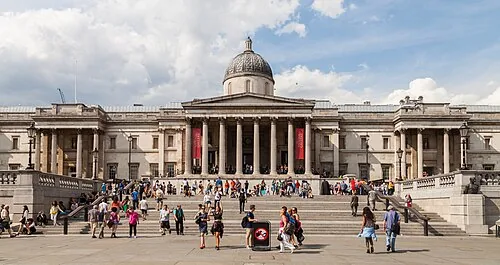
The National Gallery holds the national collection of Western European painting from about 1250 to 1900, some 2,300 works, in the Wilkins building on the north side of Trafalgar Square. It was founded in 1824 with 38 pictures bought from a private collection and has always been free to enter, which remains true of the permanent collection. Van Eyck, Leonardo, Titian, Rembrandt, Turner and Van Gogh are all here, often in the same hour's walk.
Open in the planner → Tours and entry ticketsGetting there
Charing Cross, on the Northern and Bakerloo lines and the rail network, is three minutes from the entrance across the square. Leicester Square, on the Northern and Piccadilly lines, is four minutes from the back of the building, and Embankment adds the District and Circle lines plus a riverboat pier five minutes to the south. From Paddington or King's Cross it is around twenty minutes by Underground with one change. The main entrance is at the top of the Trafalgar Square steps; the Sainsbury Wing entrance at the west end is often quicker.
What you see
The collection is hung chronologically, which makes a sensible route. Start in the Sainsbury Wing for the early Italian and Northern pictures: the Wilton Diptych, Van Eyck's Arnolfini Portrait, Uccello's Battle of San Romano, Piero della Francesca's Baptism of Christ and Leonardo's Virgin of the Rocks. Move east into the main building for the sixteenth century — Holbein's Ambassadors, Bronzino, Titian, Veronese — then into the great square rooms for Rembrandt's self-portraits, Velazquez's Rokeby Venus, Vermeer, and the Dutch landscape painters. The west and north rooms carry the eighteenth and nineteenth centuries: Canaletto, Gainsborough, Constable, Turner's Fighting Temeraire and Rain, Steam and Speed, then Monet, Manet, Degas, Cezanne, Seurat's Bathers and Van Gogh's Sunflowers. If you have an hour, skip to the Sainsbury Wing and the Impressionist rooms and accept that you have missed the middle.
What to pair it with
Trafalgar Square is at the foot of the steps, the National Portrait Gallery is immediately behind the building on St Martin's Place, and Covent Garden is a ten-minute walk north-east.
When to go
Weekday mornings in the first hour are genuinely calm, even in summer. Late afternoon thins out again, and the gallery holds a late opening one evening a week which is one of the better ways to see it. Weekends and school holidays fill the central rooms by late morning, and the Sunflowers and the Leonardo attract standing crowds all day. Winter weekday afternoons are the quietest of all.
What is hard about it
The permanent collection is free but special exhibitions are ticketed and often need booking. The building is large and confusingly linked, the room numbering has changed with recent rebuilding, and rooms close for rehanging without warning, so a picture you came for may be off display — check the collection pages before you travel if it matters. Floors are hard and seating is sparse; two hours in is where most people flag. The cloakroom and the main cafe both get congested at midday, and the Trafalgar Square entrance involves steps, with level access at the Sainsbury Wing.
Common questions
How long do you need at the National Gallery?
Two hours gives you a proper walk through the highlights. An hour works if you pick two wings and ignore the rest.
Is the National Gallery free?
Yes, the permanent collection is free to enter with no ticket needed. Temporary exhibitions are charged separately.
What should I see if I only have an hour?
The Sainsbury Wing for Van Eyck and Leonardo, then straight through to the nineteenth-century rooms for Turner, Monet and Van Gogh.
Nearby
- Big Ben and the Houses of ParliamentThe Elizabeth Tower and the Palace of Westminster on the Thames
- Westminster AbbeyCoronation church since 1066, and burial place of monarchs and poets
- Churchill War RoomsThe underground bunker from which Britain ran the Second World War
- Trafalgar SquareNelson's Column, the lions and the Fourth Plinth
More of the same kind
- British MuseumThe Rosetta Stone, the Parthenon sculptures and eight million other objects
- HMS BelfastSecond World War cruiser moored in the Pool of London, nine decks to explore
- Tate ModernModern and contemporary art in a converted power station, free to enter
- Imperial War MuseumConflict from 1914 to now, including a serious Holocaust gallery
Part of these routes
- Westminster in a dayParliament, the Abbey, the bunker under Whitehall and the royal parks, almost all on foot.
- Bloomsbury and the galleriesThe British Museum at opening time, then paintings at Trafalgar Square and Millbank.
- London in three daysThe short list, ordered so each day holds together and nothing is crossed twice.
- London in five daysA fuller first visit: the centre, the City, the museums, the South Bank and a day in Greenwich.
- London at lengthEverything the other routes cover, spread over eight unhurried days with nothing rushed.