HMS Belfast
Second World War cruiser moored in the Pool of London, nine decks to explore
- Area Southwark
- Type Museum
- Time needed 1h 30m
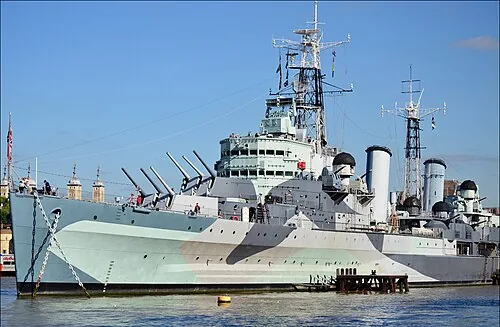
HMS Belfast is a Royal Navy light cruiser launched in 1938, which served at the Battle of North Cape in 1943 and supported the Normandy landings in 1944. She has been moored permanently in the Pool of London between London Bridge and Tower Bridge since 1971 and is part of the Imperial War Museum. Nine decks are open, from the bridge down to the boiler and engine rooms below the waterline. It is a ship visit, which means ladders, hatches and low steel doorways rather than galleries.
Open in the planner → Tours and entry ticketsGetting there
London Bridge (Jubilee and Northern lines, plus national rail) is about five minutes' walk, down to the river and east along Queen's Walk past Hay's Galleria. Monument (Circle and District) is ten minutes if you cross London Bridge on foot. Tower Hill is about twelve minutes via Tower Bridge. Riverboat services call at London Bridge City Pier, which is a two-minute walk and the most appropriate way to arrive. The entrance is on the pontoon off Queen's Walk, reached by a gangway.
What you see
You board amidships and work outwards. On the upper deck are the two forward six-inch gun turrets, A and B, trained west — their guns are laid on a point in central London, and the ship's armament and its range are the first thing the layout explains. The bridge and the admiral's bridge above it are reconstructed as they were in 1943, with the compass platform, the voice pipes and the plotting instruments. Below that the operations room and the transmitting station show how gunnery was actually directed before radar displays became familiar. Going down, the sick bay, dentist's chair, galley, laundry, chapel and mess decks are fitted out with the clutter and fittings of a ship with a crew of around nine hundred, and the sense of how little space each man had is the strongest impression most people take away. Deeper still are the shell rooms and magazines, the boiler rooms with their burners and gauges, and the engine rooms, which are reached down vertical ladders through hatches and are the most atmospheric and most physically demanding part of the ship. Exhibitions on the ship's war service, on the Arctic convoys and on life aboard are set into spaces along the route. Up on the quarterdeck you get the view back to Tower Bridge and the Tower of London across the water.
What to pair it with
Tower Bridge is about eight minutes east along the south bank, and the Tower of London is a short walk beyond it across the river. Borough Market and Southwark Cathedral are five minutes west. The Shard is directly behind London Bridge station.
When to go
Weekday mornings are quietest. School holidays and weekends bring families, and the narrow passages and ladders become slow when there is a queue at every hatch. The ship is cold, draughty and damp below decks in winter and hot in the upper compartments in summer. Light on the quarterdeck is best in the late afternoon, looking downstream at Tower Bridge. Opening is year-round but hours shorten in winter — check before you go.
What is hard about it
This is a steep, cramped, physical visit. Getting between decks means steep stair ladders, some near vertical, and the engine and boiler rooms involve climbing down through hatches with handrails; the lower decks are not accessible to wheelchair users and are hard going for anyone with limited mobility, bad knees or a fear of enclosed spaces. Doorways are low steel ovals and hitting your head is routine — the warnings are there for a reason. Pushchairs cannot be taken below the upper decks. The route is largely one-way and narrow, so you cannot easily double back or let a group past. Entry is charged and not cheap for the time most people spend aboard, and booking online in advance is normally cheaper. Some compartments close for maintenance without notice. Visitors expecting a large museum with exhibits sometimes find the interpretation thin and the appeal is really the ship herself.
Common questions
How long do you need on HMS Belfast?
Around ninety minutes to walk all nine decks at a reasonable pace, including the engine and boiler rooms. An hour is enough if you skip the lowest decks.
Is HMS Belfast suitable for people with limited mobility?
Only partly. The upper decks and some exhibition spaces are reachable, but the lower decks need steep ladders and hatches and there is no lift between most levels.
Is it worth it for children?
Generally yes — the ladders, turrets and engine rooms hold attention better than a museum does. Watch heads on the low doorways, and note that pushchairs cannot go below the upper decks.
Nearby
- Borough MarketFood market under the railway arches, trading on the site since the 1100s
- The ShardWestern Europe's tallest building, with a viewing gallery on floors 68 to 72
- Imperial War MuseumConflict from 1914 to now, including a serious Holocaust gallery
More of the same kind
- Churchill War RoomsThe underground bunker from which Britain ran the Second World War
- National GalleryWestern European painting from Van Eyck to Van Gogh, free to enter
- British MuseumThe Rosetta Stone, the Parthenon sculptures and eight million other objects
- Tate ModernModern and contemporary art in a converted power station, free to enter
Part of these routes
- London at warThe cabinet bunker, the museum of twentieth-century conflict and a cruiser still moored in the Pool.
- London in five daysA fuller first visit: the centre, the City, the museums, the South Bank and a day in Greenwich.
- London at lengthEverything the other routes cover, spread over eight unhurried days with nothing rushed.