Imperial War Museum
Conflict from 1914 to now, including a serious Holocaust gallery
- Area Southwark
- Type Museum
- Time needed 2h
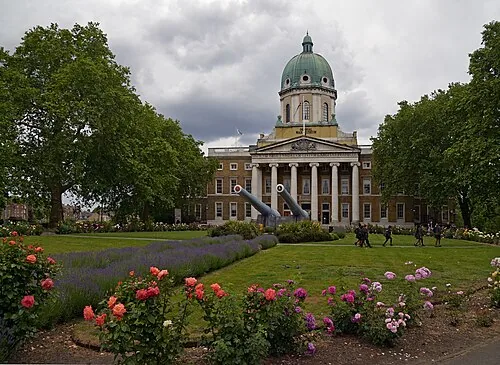
The Imperial War Museum sits in Southwark, in the surviving central block of the former Bethlem Royal Hospital, under a copper dome and behind two very large naval guns. It covers British and Commonwealth experience of conflict from 1914 to the present, and it is free to enter. The permanent Holocaust Galleries, rebuilt and reopened in 2021, are the most serious thing in the building and the reason many people come.
Open in the planner → Tours and entry ticketsGetting there
Lambeth North on the Bakerloo line is the nearest station, about five minutes' walk. Elephant and Castle, on the Bakerloo and Northern lines with rail services, is a ten-minute walk and better connected. Waterloo is fifteen minutes on foot through the back streets, which is a reasonable option if you are already on the South Bank. Southwark on the Jubilee line is a similar distance. Buses along Lambeth Road and St George's Road stop outside the park gates.
What you see
You come into the atrium, a tall open well with aircraft and vehicles hung at every level: a Spitfire and a Harrier overhead, a V-2 rocket standing on end, a Mark V tank, a section of the Berlin Wall. The First World War galleries are in the basement and are the museum's strongest conventional display, taking you from 1914 through recruitment, the trenches, the home front and the collapse of 1918 with objects, letters and sound rather than triumph. Second World War and Holocaust galleries occupy upper floors and are designed to be walked in sequence; the Holocaust Galleries use personal objects, film and testimony, are unflinching, and take an hour on their own. Higher still, the Lord Ashcroft Gallery holds the largest collection of Victoria Crosses in the world, and the top-floor spaces handle conflict since 1945, including Northern Ireland, Iraq and Afghanistan. Outside, the surrounding Geraldine Mary Harmsworth Park is a decent place to sit afterwards, which you may want.
What to pair it with
The Southbank Centre and the London Eye are a fifteen-minute walk north-west. Tate Modern is twenty minutes north-east along Blackfriars Road. The Garden Museum at Lambeth Palace is ten minutes west.
When to go
Weekday mornings are much the quietest, and the Holocaust Galleries in particular are better with few people in them. School groups fill the atrium and the First World War galleries from mid-morning on term-time weekdays. Weekends and school holidays are busy throughout. Around Remembrance in early November the museum is busier and often has additional programming. Timed entry to the Holocaust Galleries may apply, so check before you go.
What is hard about it
The Holocaust Galleries are harrowing by design and are not recommended for younger children; the museum sets an age guidance and it should be taken seriously. The building is confusing to navigate, with galleries entered from a spiral of floors around the atrium and routes that force you backwards. It is also a lot to absorb in one visit, and most people are worn out after two hours, which means the post-1945 floors get skipped. Major temporary exhibitions are ticketed. Some visitors come expecting hardware and find comparatively little of it, since the museum is more interested in experience than in machines.
Common questions
How long do you need at the Imperial War Museum?
Two hours is a realistic visit covering the atrium, the First World War galleries and one upper floor. The Holocaust Galleries alone need about an hour.
Is the Imperial War Museum free?
Yes, general entry is free. Larger temporary exhibitions are ticketed separately.
Is it suitable for children?
The atrium, vehicles and aircraft work well for children. The Holocaust Galleries carry an age guidance and are not appropriate for younger visitors.
Nearby
- HMS BelfastSecond World War cruiser moored in the Pool of London, nine decks to explore
- Borough MarketFood market under the railway arches, trading on the site since the 1100s
- The ShardWestern Europe's tallest building, with a viewing gallery on floors 68 to 72
More of the same kind
- Churchill War RoomsThe underground bunker from which Britain ran the Second World War
- National GalleryWestern European painting from Van Eyck to Van Gogh, free to enter
- British MuseumThe Rosetta Stone, the Parthenon sculptures and eight million other objects
- Tate ModernModern and contemporary art in a converted power station, free to enter