Natural History Museum
The blue whale in Hintze Hall, dinosaurs, and a terracotta cathedral of a building
- Area South Kensington
- Type Museum
- Time needed 2h
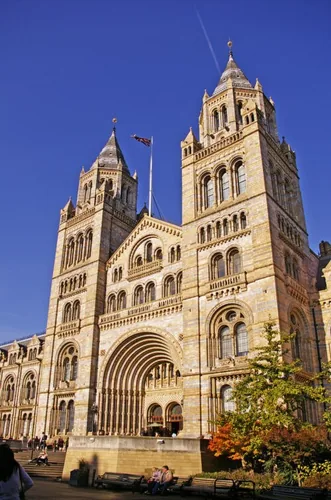
The Natural History Museum occupies Alfred Waterhouse's terracotta building on Cromwell Road in South Kensington, opened in 1881 and deliberately designed to look like a cathedral to nature. It holds about 80 million specimens, and the thing people come for is the blue whale skeleton suspended in the full length of Hintze Hall. Entry is free.
Open in the planner → Tours and entry ticketsGetting there
South Kensington on the Circle, District and Piccadilly lines is the station, and the pedestrian subway from the ticket hall runs underground almost to the museum door, which is a real advantage in rain. The walk is about five minutes either way. Gloucester Road is ten minutes. From Piccadilly Circus or King's Cross the Piccadilly line runs direct. Buses along Cromwell Road stop outside the main entrance, and the Exhibition Road side entrance is often much quieter than the Cromwell Road steps.
What you see
Hintze Hall first: a vaulted, arcaded nave in carved terracotta with the blue whale skeleton diving overhead, and specimen cases set into the alcoves on both levels. Go up the stairs at the far end for the view back along the whale. From there the museum splits by colour-coded zone. The Blue Zone holds the dinosaurs, including a Stegosaurus skeleton and a Tyrannosaurus animatronic, plus the mammal hall with its full-size blue whale model. The Red Zone, entered from Exhibition Road, deals with earth sciences and is reached by an escalator through a vast metal globe: volcanoes, earthquakes and a serious collection of minerals and meteorites in the long Victorian Vault gallery. The Green Zone has the carved monkeys climbing the arches, a slice of giant sequoia, and the quiet old-fashioned bird and fossil galleries, where you will find far fewer people. Look at the building throughout: every column, arch and panel carries carved plants and animals, extinct species on one side of the hall and living ones on the other.
What to pair it with
The Victoria and Albert Museum is three minutes east on Cromwell Road. The Science Museum is next door on Exhibition Road. Hyde Park and the Albert Memorial are ten minutes north.
When to go
Weekday mornings in term time are the only genuinely comfortable option, and even then arrive at opening. From mid-morning on any weekend or school holiday the dinosaur gallery becomes a one-way shuffle and the queue to get in stretches down the Cromwell Road steps. Use the Exhibition Road entrance to skip much of that queue. Late openings on one evening a month are adult-oriented and much calmer. Winter brings an outdoor ice rink to the east lawn and more crowds with it.
What is hard about it
The crowds are the central problem, and families with young children should know that the dinosaur gallery at peak times is unpleasant rather than exciting. Queues to enter can be long even though entry is free, and bag checks slow things further. The museum is enormous and the zone layout is not intuitive, so expect to backtrack. Some galleries, particularly in the Green Zone, are dated and have not been refreshed in decades, which can read as charming or as neglected. Special exhibitions are ticketed and normally need booking. Cafes are crowded and expensive, and there is no easy quiet corner to eat in.
Common questions
How long do you need at the Natural History Museum?
Two hours covers Hintze Hall, the dinosaurs and one other zone. A full visit to all four zones would take a day.
Is the Natural History Museum free?
Yes, general entry is free. Major temporary exhibitions are ticketed, and booking a free entry slot is sometimes advised at peak times.
How do you avoid the queue?
Use the Exhibition Road entrance rather than the main Cromwell Road steps, and arrive at opening on a weekday. Weekends and school holidays are the worst.
Nearby
- Victoria and Albert MuseumDesign and decorative arts across 145 galleries, free to enter
- Science MuseumStephenson's Rocket, the Apollo 10 capsule and a lot for children to press
- Royal Albert HallVictorian rotunda, home of the Proms, with daytime tours
More of the same kind
- Churchill War RoomsThe underground bunker from which Britain ran the Second World War
- National GalleryWestern European painting from Van Eyck to Van Gogh, free to enter
- British MuseumThe Rosetta Stone, the Parthenon sculptures and eight million other objects
- HMS BelfastSecond World War cruiser moored in the Pool of London, nine decks to explore
Part of these routes
- The South Kensington museumsThree of the world's great free museums within one block, and the Albert Hall behind them.
- London in three daysThe short list, ordered so each day holds together and nothing is crossed twice.
- London in five daysA fuller first visit: the centre, the City, the museums, the South Bank and a day in Greenwich.
- London at lengthEverything the other routes cover, spread over eight unhurried days with nothing rushed.