Victoria and Albert Museum
Design and decorative arts across 145 galleries, free to enter
- Area South Kensington
- Type Museum
- Time needed 2h
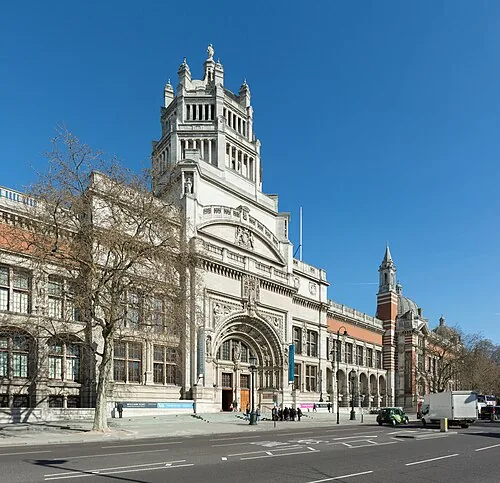
The Victoria and Albert Museum holds the national collection of art, design and the decorative arts across roughly 145 galleries on Cromwell Road in South Kensington. It opened in its present form in 1857 out of the profits of the Great Exhibition, and it is free to enter. People come for furniture, ceramics, fashion, metalwork, sculpture and textiles rather than paintings, and for the building itself, which is as much an exhibit as anything in it.
Open in the planner → Tours and entry ticketsGetting there
South Kensington is the station, served by the District, Circle and Piccadilly lines, and it is about ten to fifteen minutes from the centre on the District or Circle. From the ticket hall a pedestrian subway runs under Exhibition Road and brings you out close to the museum entrances, which is the dry route in bad weather; walking up at street level takes four or five minutes. Knightsbridge on the Piccadilly line is a ten-minute walk from the east. Buses along Cromwell Road and Brompton Road stop within a couple of minutes of the main door.
What you see
Enter under the dome on Cromwell Road, where a large blown-glass chandelier hangs over the information desk, and the sculpture galleries open straight ahead. The ground floor holds the Cast Courts, two tall halls of plaster casts taken from European monuments in the nineteenth century, including a full-height cast of Trajan's Column in two pieces because it would not fit in one. Nearby are the Medieval and Renaissance rooms and the China, Japan, Korea, Islamic Middle East and South Asia galleries, which contain some of the collection's strongest single objects. Upstairs the British Galleries run through several centuries of domestic interiors, with whole panelled rooms lifted and reinstalled; higher again are the ceramics galleries, long corridors of shelved pots that few visitors reach. The jewellery gallery, the fashion gallery in its circular room and the silver galleries are the other sections worth planning for. The John Madejski Garden in the central courtyard is the place to stop, and the original refreshment rooms off it, decorated in the 1860s, were the first museum restaurant anywhere.
What to pair it with
The Science Museum and the Natural History Museum are both within a few minutes' walk on the same street, and the Royal Albert Hall and the Albert Memorial are at the top of Exhibition Road. Harrods is about fifteen minutes east along Brompton Road.
When to go
Weekday mornings soon after opening are the quietest, and late afternoon thins out again. Weekends and school holidays are busy in the entrance hall and the fashion and jewellery galleries, though the upper ceramics floors stay empty almost whatever the day. The museum runs late openings on one evening a week, when the courtyard is lit and the atmosphere is different; check before you go. Winter suits it, because nothing here depends on daylight.
What is hard about it
It is too big to see properly, and the usual mistake is to wander until tired rather than choosing three or four galleries. The layout is genuinely confusing, with half-levels, dead ends and galleries that connect only at one corner, so expect to retrace your steps even with the map. Entry is free but the large temporary exhibitions are ticketed and often need booking, and they can be crowded enough to be unpleasant. Lifts exist but are not always near where you are, and the building has a lot of stairs and hard floors. The courtyard cafe queues badly at lunchtime.
Common questions
How long do you need at the V&A?
Two hours is a sensible first visit covering three or four galleries. A full day is possible but most people flag after about three hours.
Is the V&A free?
The permanent collection is free to enter. Major temporary exhibitions are ticketed and normally need booking in advance.
Is it better than the Natural History Museum for children?
Generally no. The V&A has some hands-on areas and a children's trail, but the Natural History Museum and the Science Museum next door are built around younger visitors.
Nearby
- Natural History MuseumThe blue whale in Hintze Hall, dinosaurs, and a terracotta cathedral of a building
- Science MuseumStephenson's Rocket, the Apollo 10 capsule and a lot for children to press
- Royal Albert HallVictorian rotunda, home of the Proms, with daytime tours
More of the same kind
- Churchill War RoomsThe underground bunker from which Britain ran the Second World War
- National GalleryWestern European painting from Van Eyck to Van Gogh, free to enter
- British MuseumThe Rosetta Stone, the Parthenon sculptures and eight million other objects
- HMS BelfastSecond World War cruiser moored in the Pool of London, nine decks to explore
Part of these routes
- The South Kensington museumsThree of the world's great free museums within one block, and the Albert Hall behind them.
- London in five daysA fuller first visit: the centre, the City, the museums, the South Bank and a day in Greenwich.
- London at lengthEverything the other routes cover, spread over eight unhurried days with nothing rushed.