Science Museum
Stephenson's Rocket, the Apollo 10 capsule and a lot for children to press
- Area South Kensington
- Type Museum
- Time needed 2h
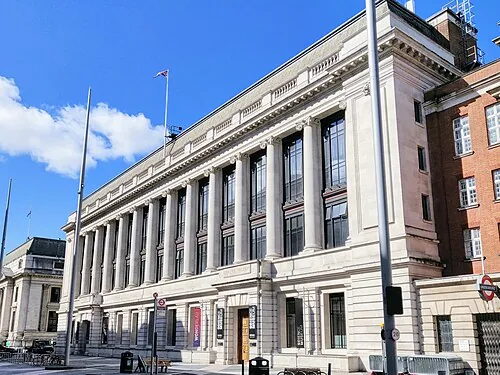
The Science Museum sits on Exhibition Road in South Kensington and is free to enter. Its strength is real machinery and real spacecraft rather than screens: Stephenson's Rocket, a Watt beam engine, and the Apollo 10 command module that carried three astronauts around the Moon in 1969. It descends from the collections of the Great Exhibition and shares the street with the Victoria and Albert and Natural History museums.
Open in the planner → Tours and entry ticketsGetting there
South Kensington on the District, Circle and Piccadilly lines is the nearest station, roughly ten to fifteen minutes from central London. Take the pedestrian subway from the ticket hall and follow the signs; it comes out a short walk from the museum entrance on Exhibition Road. At street level the walk is about five minutes uphill. Gloucester Road, also on three lines, is a ten-minute walk and is sometimes less crowded at the exit. Buses run along Cromwell Road at the bottom of Exhibition Road.
What you see
The ground floor opens into the Energy Hall, a long gallery of stationary steam engines, with Stephenson's Rocket among the early locomotives. Beyond it the space gallery holds rockets, satellites and the scorched Apollo 10 capsule, which is smaller than almost everyone expects. Upstairs the museum turns to mathematics, computing and communication, with early calculating machines and a sequence on codebreaking and the first computers; the clocks and watches collection is quieter and very good. The flight gallery near the top of the building hangs full aircraft from the ceiling and lets you walk between them at wing height. Wonderlab, the paid hands-on gallery, is where children spend their time, with friction slides, chemistry benches and a planetarium show. The medicine galleries on the first floor are the most serious part of the museum and are worth a slow half-hour if you are not herding anyone.
What to pair it with
The Victoria and Albert Museum and the Natural History Museum are both a two-minute walk, and the Royal Albert Hall is at the top of Exhibition Road. Hyde Park and Kensington Gardens are ten minutes north on foot.
When to go
Weekday mornings in term time are much the best. Weekends, half-terms and rainy school holidays fill the building, and the hands-on galleries can reach a point where children cannot get to the exhibits at all. Late afternoon on a weekday is the second-best window. Season barely matters, except that wet weather in the holidays is the worst possible combination.
What is hard about it
The main museum is free, but Wonderlab and the planetarium and simulator shows are ticketed, and families who turn up without booking them often find the slots gone. Noise is the real drawback: on a busy day the ground-floor galleries are loud enough to be tiring for adults. The upper floors are genuinely quiet by comparison, which also means the museum empties out unevenly and some displays are dated. There are lots of stairs between galleries, though lifts reach every floor. The cafes are adequate rather than good and queue heavily at lunch.
Common questions
How long do you need at the Science Museum?
About two hours for the main galleries. Add an hour if you are doing Wonderlab with children.
Do you need to book tickets?
General entry is free, though a timed entry slot may be required at busy times. Wonderlab, the planetarium and special exhibitions are ticketed and should be booked ahead.
Can you do the Science Museum and the Natural History Museum in one day?
Yes, they are two minutes apart, but it is a long day. Two hours each with a break between is about the limit for most people.
Nearby
- Natural History MuseumThe blue whale in Hintze Hall, dinosaurs, and a terracotta cathedral of a building
- Victoria and Albert MuseumDesign and decorative arts across 145 galleries, free to enter
- Royal Albert HallVictorian rotunda, home of the Proms, with daytime tours
More of the same kind
- Churchill War RoomsThe underground bunker from which Britain ran the Second World War
- National GalleryWestern European painting from Van Eyck to Van Gogh, free to enter
- British MuseumThe Rosetta Stone, the Parthenon sculptures and eight million other objects
- HMS BelfastSecond World War cruiser moored in the Pool of London, nine decks to explore